Showing posts with label Honeymoon. Show all posts

Thursday, October 30, 2025

A Historic Trek: The Amazing Honeymoon of W.F. Traughber and Nora Petree Traughber in 1905, Part VII

Chasing History: Exploring My Ancestral Roots - Blog Post #53
By Tonya Graham McQuade

American explorer, military leader, and politician John Charles

Frémont in front of the Fremont Tree, 1888.


Back in September of last year, I started a series of blog posts about the “historic honeymoon” my great grandparents, Frank and Nora Traughber, took back in 1905. My father had recently given me their old photo album, and I had decided to “dig in” to the story of their lives. After getting married in San Jose on August 17, 1905 (see this post about their wedding), they set off on a four-week honeymoon that took them throughout California, Oregon, Washington, Montana, and Utah before heading back to Missouri, where Frank (aka. Dr. William Francis Traughber) had his medical practice. Mike and I had been to many of those same places, so I wanted to see how their experiences might have compared to ours.


The first post in the honeymoon series talked about the time Frank and Nora spent in Del Monte (aka. Monterey), Pacific Grove, and Santa Cruz (see this link for more details and photos), but I barely touched on the Santa Cruz aspect of their trip. The photos in their scrapbook that were labeled “the big trees in Santa Cruz” were quite faded and discolored, and at the time they didn’t really capture my attention. These past few days, though, I started researching more about their time in Santa Cruz because I am working on expanding that blog series into a travelogue-style book that tells about their adventures. And guess what? Their story and photos got more interesting the more I learned.


Nora standing beside a giant Coastal Redwood  in the Santa Cruz Mountains.


Frank playfully climbing up into a giant redwood – the two trunks 

have fused together through a process called inosculation. 


There are several photos of Frank and Nora in the album showing them among the big trees. So, the first question I had to ask was, where exactly did they go? Which big trees did they see? And how did they get there? Big Basin State Park had opened in 1902 as the first California State Park, so I knew that was a possibility, but it seemed like getting there from Monterey for an afternoon visit would have presented quite a challenge. Back in 1905, the main route to Big Basin was a rough, rutted wagon road that connected it to the nearby town of Boulder Creek, and with no railway option, visitors had to arrive by horse-drawn vehicles. The journey was a major undertaking, even for those living nearby.


The Santa Cruz & Felton Railroad crosses a trestle on the way to Big Tree Grove. 

Photo courtesy of the Santa Cruz Museum of Art & History. [1]


I quickly figured out with a bit of online research that Frank and Nora would have had easy access to a very popular tourist attraction of their day: Welch Big Tree Grove in the Santa Cruz Mountains. Popularly called “Santa Cruz Big Trees,” thousands of visitors had toured the grove since it opened in 1867, with access made much easier by the opening of the first railway in 1875 (Big Basin never gained railway access). Visitors at Monterey’s Hotel Del Monte, where Frank and Nora were staying, could board the Southern Pacific Railroad at Del Monte station bound for Santa Cruz, then transfer to a local line, the Santa Cruz Big Trees & Pacific Railway, for the ride to Big Tree Station. Welch Big Tree Grove, later known as Santa Cruz County Big Trees Park after becoming a county park in 1930, operated until 1942, when it closed down due to World War II. It is now part of Henry Cowell Redwoods State Park. 


Entrance sign to Henry Cowell Redwoods State Park near Felton.

Photo by Tonya McQuade.


Those who know me know I am a big fan of both state and national parks. My car, as well as my computer, bear stickers for each. I’m also extremely grateful to people like John Muir, Theodore Roosevelt, Stephen Mather, Charles Young, Minerva Hamilton Hoyt, Marjorie Stoneman, Thomas Moran, and so many more for the work they did to help preserve the trees, wildlife, and beauty of our national parks for posterity. 


The cover of my laptop clearly “advertises” my love of state and national parks.


I have also always loved walking among the towering Coastal Redwoods in places like Redwood National Park and Big Basin State Park, as well as the Giant Sequoias found further inland in places like Yosemite’s Mariposa Grove and Calaveras Big Trees State Park, so I wanted to know more about how the privately-owned Welch Big Tree Grove became Henry Cowell Redwoods State Park. I also could not remember if I had actually walked through the specific Redwood Grove that Frank and Nora would have seen.


So yesterday, I suggested to Mike that we drive to Henry Cowell Redwoods State Park, which is just thirty miles from our house, and go for a hike through the Redwood Grove. What follows includes some information from the research I did these past couple days, as well as additional information from the Visitors Center, the park map and brochure, the Redwood Grove Loop Trail Guide, and the book I purchased at the gift store: Historic Tales of Henry Cowell Redwoods State Park - Big Tree Grove, by Deborah Osterberg.


The book I bought at the gift shop yesterday — it’s full  of interesting photos and information.


When Joseph Warren Welch, Sr. purchased this amazing grove in 1867, he fortunately saved it from the logging that would have likely been its fate. Many of the other big trees around it had already been cut down – either for their wood or to fuel the lime kilns that were big business in the Santa Cruz Mountains in those days (that was actually how the Cowell family earned much of their money). Only about 5 percent of all the old-growth redwoods that stood before 1949 are still standing.


Welch, instead, turned his grove into a tourist attraction, with a hotel, dining hall, cabins, and a dance pavilion. His wife Anna was a big motivation for this. In the photo below, Nora is standing in front of one of the Welch resort buildings, though I am not sure which one. The buildings, which stood near the Fremont Tree, have all since been removed.


Nora standing in front of one of the old resort buildings,

which have now been removed.


The Fremont Tree was one of the park’s biggest attractions. According to reports, Second Lieutenant John Charles Frémont of the U.S. Army Corps of Topographical Engineers had visited this grove in the San Lorenzo Valley in 1846 with his scout, the legendary mountain man Kit Carson, on his third scientific expedition to the West. “The accounts of the great trees in the forest on the west slope of the mountain,” according to his memoirs, “had roused [his] curiosity,” so he wanted to see them for himself [2]. Frontiersman and early Santa Cruz Mountain pioneer Isaac Graham, who knew Kit Carson from his fur-trapping days and lived in a small logging settlement in the area, served as Frémont’s host.


Frémont had earned the nickname “the Pathfinder” due to his celebrated explorations, and his exciting descriptions of those travels (aided by his wife Jessie’s pen) had caused his accounts to become national bestsellers. His descriptions of the giant Coastal Redwoods first sparked skepticism and disbelief, then fascination and excitement, among his fans, and many wanted to see the big trees for themselves. California at the time was still under Mexican control, but that didn’t stop adventurous settlers from moving in.


Here I am, sort of copying Frank’s pose from above; these two trunks have fused together through a process called inosculation.


Graham had arrived in the Santa Cruz Mountains in 1841, where he established a distillery at Rancho Zayante (near present-day Felton), one of the Mexican land grants in the area. He also built one of the first water-powered saw mills, along with Danish immigrant Peter Lassen. Graham built the road now known as Graham Hill Road, on which Mike and I drove yesterday when we visited Henry Cowell Redwoods State Park, to transport his timber to the coast for shipment. Later, the railroad helped with that challenging task.


At Graham’s request, Frémont spent several days measuring the largest tree in the grove, and he found that it measured 275 feet in height and 15 feet in diameter, three feet above the base. [3] That tree later became known as “The Giant” and is still called that today. You can see a few views of it below in the photos I took yesterday.


This tree, known as "The Giant," is the one that Fremont measured. It stands 282 feet tall, over 17 feet wide, and weighs over 400 tons. It used to be even taller until part of the top of the tree broke off. Photo by Tonya McQuade.


Mike and I standing in front of “The Giant” on our recent excursion.


This large burl hangs off the side of The Giant; burls are natural,
knobby growths filled with dormant buds and can be a result of past damage,
like a fire, from which the tree has recovered. Photo by Tonya McQuade. 

When Welch and his family later owned the grove, it became a common practice for visitors to tack their notes and calling cards on “The Giant,” as well as on other neighboring trees, as seen below. This practice was eventually called out by a well-known conservationist, as you’ll soon discover.

This photo from Deborah Osterberg’s book describes the Giant
as wearing "a great corset of cards." [4]

Another nearby tree called the “Fremont Tree” was reputed to be where Frémont slept during his 1846 visit, for it had been hollowed out by fire, providing a cavity measuring approximately twelve by fifteen feet with a ceiling about twenty-six feet high. [5] An 1862 article in the Santa Cruz Weekly Sentinel claimed that thirty people could stand inside of it. [6] When Frémont visited the grove again in 1888, he posed in front of the tree with his wife and daughter. Asked by a reporter whether that account was true, he reportedly said, “It’s a good story; let it stand,” according to the park brochure.

To see the rest of this post, head over to my website at this link ...


Endnotes:
1. Osterberg, Deborah. Historic Tales of Henry Cowell Redwoods State Park: Big Trees Grove. History Press, 2020. Pg. 48.
2. Fremont, John Charles. Memoirs of My Life by John Charles Fremont. Vol. 1. Chicago: Belford, Clarke & Company, 1887. Hathi Trust Digital Library, babel.hathitrust.org. Pg. 457.
3. Osterberg, pg. 26.
4. Ibid, pg. 53.
5. Ibid, pg. 55.
6. Ibid, pg. 56.

Tuesday, November 12, 2024

A Historic Trek: The Amazing Honeymoon of W.F. Traughber and Nora Petree Traughber in 1905, Part VI

Chasing History: Exploring My Ancestral Roots - Blog Post #47

By Tonya McQuade


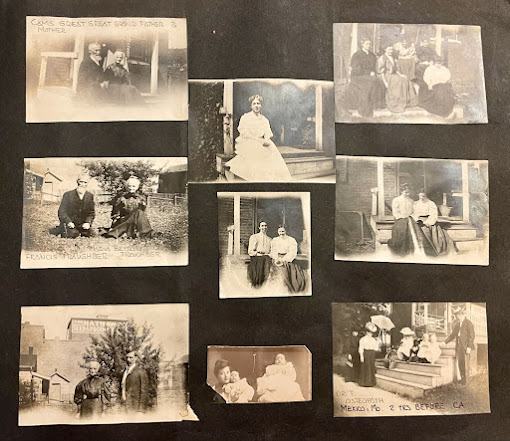
A page from the Traughber photo album filled with family photos

Over the last six weeks in my blog posts, I have described the wedding and adventurous honeymoon my great-grandparents Frank and Nora Traughber enjoyed in August and September of 1905. I started by describing their wedding in San Jose at the Petree House, then moved on to their honeymoon adventures in Del Monte (Monterey), Pacific Grove, and Santa Cruz (Part I); Catalina Island (Part II); San Francisco (Part III), the Pacific Northwest (Part IV), and finally Yellowstone National Park (Part V).


They also visited Missoula, Montana, and Salt Lake City, Utah. However, since I have no photos or details from those stops, I have decided to skip ahead to their ultimate destination: Mexico, Missouri, where they planned to begin their married life together. That is where their photo album next picks up. Frank and Nora arrived in Mexico in mid-September of 1905 after their four-week honeymoon trek. What stories they must have had to tell! 


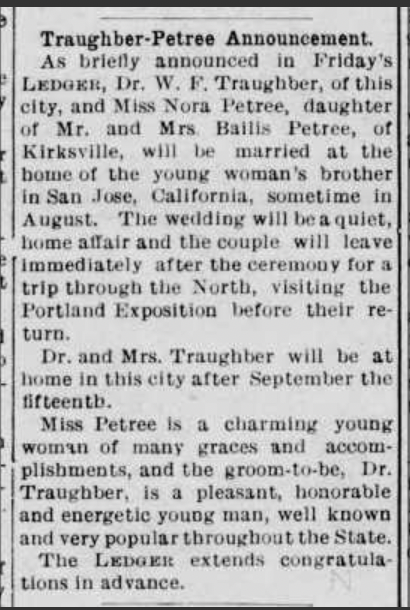
Wedding Announcement in the Mexico Weekly Ledger, dated 15 July 1905


As seen above, the local newspaper announced their wedding in July since Frank - aka. Dr. W. F. Traughber - already had an established medical practice and residence in town. He had traveled to California for the wedding, there to join Nora who had been living in the Bay Area since she had been attending (and recently graduated from) Stanford University. The journey to Mexico was a return trip for him, to a place with which he was familiar, but this was to be a new life for Nora. I wonder how she felt about the move after experiencing life in California.


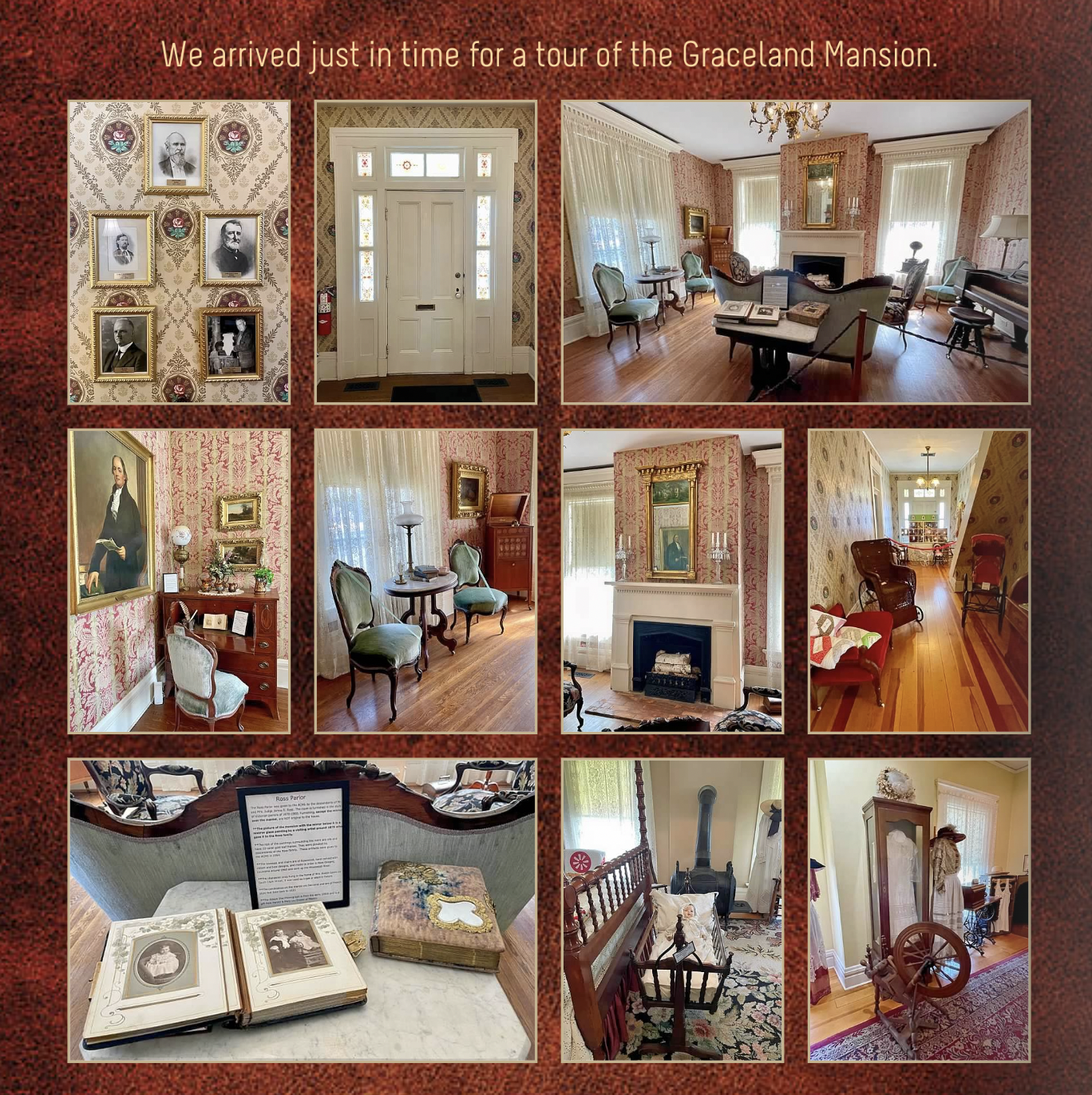
Since Mexico is just fourteen miles from Centralia and offered more hotel selections, Mike and I stayed there for two nights during our recent visit to Missouri since I had two book talks scheduled in Centralia. I was anxious to visit the history museums in both cities since we had not been able to see either on our earlier visit to the area. So, our first stop in Mexico was at the Audrain County Historical Society/Graceland Museum Complex. We arrived just in time for a tour of the Graceland Mansion, which now houses the historical society. Below is a page from the scrapbook I have been working on for our trip.


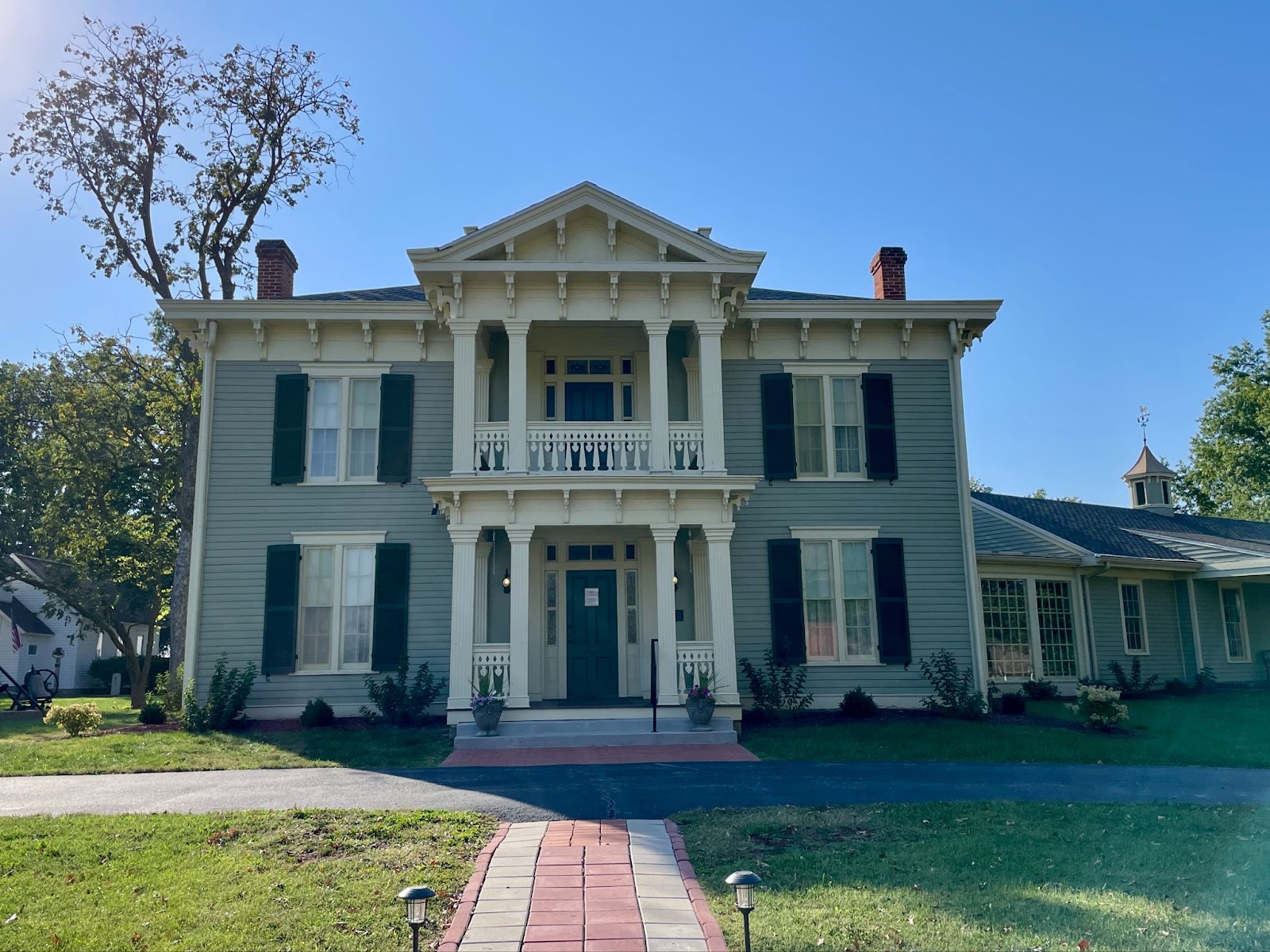
The house was built in 1857 by John P. Clark, who lived in the house until 1867. He then sold it to Colby T. Quisenberry, who renamed it “Graceland.” In was Quinsenberry who brought purebred saddle horses to Mexico (more on that later). In 1874, Quisenberry sold the house to James E. Ross, whose family lived in it for the next half century. It was the Ross family who owned the house in 1905 when Frank and Nora were in Mexico, though James Ross died in 1900. As described on the museum website, the house is a two-story, frame dwelling with Italianate style decorative features, topped by a hipped roof with widow's walk and featuring an imposing Classical Revival style two-story front portico.


Graceland Mansion, aka. the Ross House


The original owner, Clark, hosted Colonel Ulysses S. Grant for dinner on several occasions when Grant was stationed in Mexico. I'll be writing more about Mexico's Civil War connections in a post for the Emerging Civil War website. That, however, was long before Frank and Nora lived there.


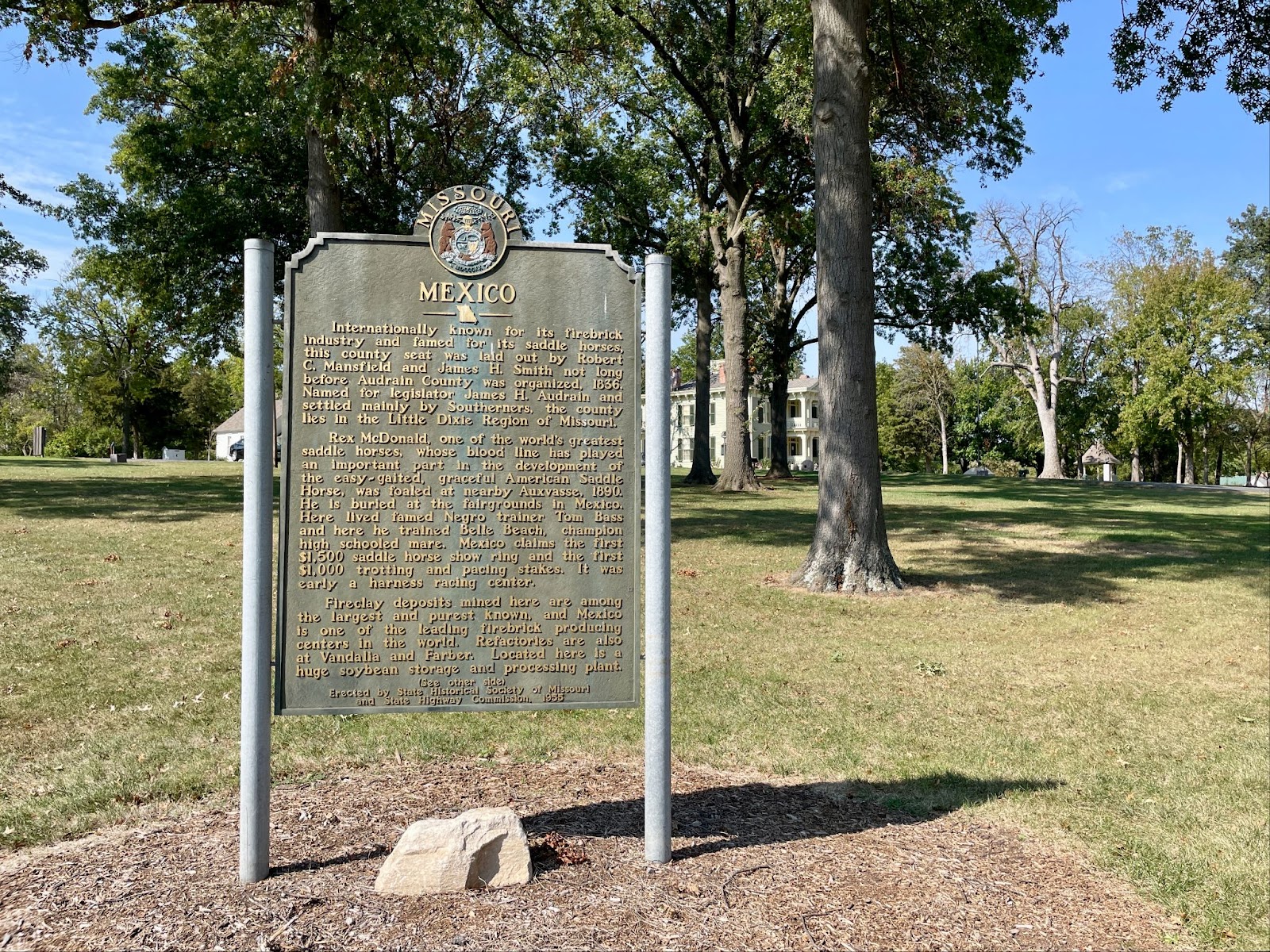
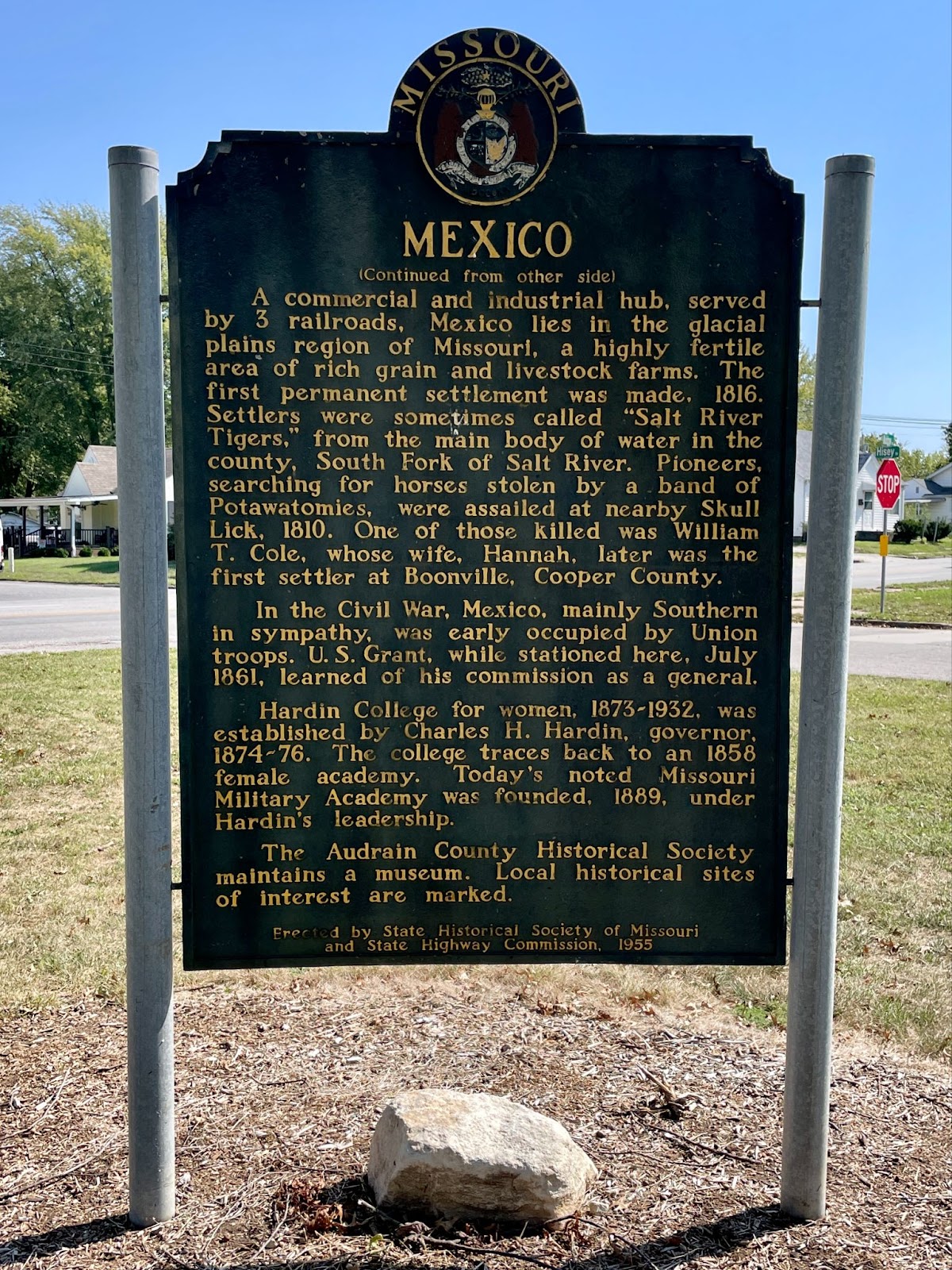
Mexico, as explained on the sign below, “was laid out by Robert C. Mansfield and James H. Smith not long before Audrain County was organized, 1836. Named for legislator James H. Audrain and settled mainly by Southerners, the county lies in the Little Dixie Region of Missouri.”  The city is “internationally known for its firebrick industry and famed for its saddle horses,” and we learned more about both of these at the museum.


Sign describing Mexico’s history in front of the Audrain County Historical Society


Back side of the informational sign about Mexico


As explained on the back side of the sign, Mexico is “a commercial and industrial hub, served by 3 railroads … [and] lies in the glacial plains region of Missouri, a highly fertile area of rich grain and livestock farms…. In the Civil War, Mexico, mainly Southern in sympathy, was early occupied by Union troops. U.S. Grant, while stationed here, July 1861, learned of his commission as a general.” 


While no battles occurred in Mexico during the war, such was not the case in nearby Centralia. I already wrote about the Centralia Massacre and the Battle of Centralia in previous blog posts, including my Traughber and Bryson family connections. Both the massacre and battle also come up in my book A State Divided: The Civil War Letters of James Calaway Hale and Benjamin Petree of Andrew County, Missouriwhich includes a letter from Hale saying he had a “lucky escape” by not getting the furlough he had requested, or he would have been on the massacred train. That’s a key reason Centralia was on the line-up for my Book Tour.


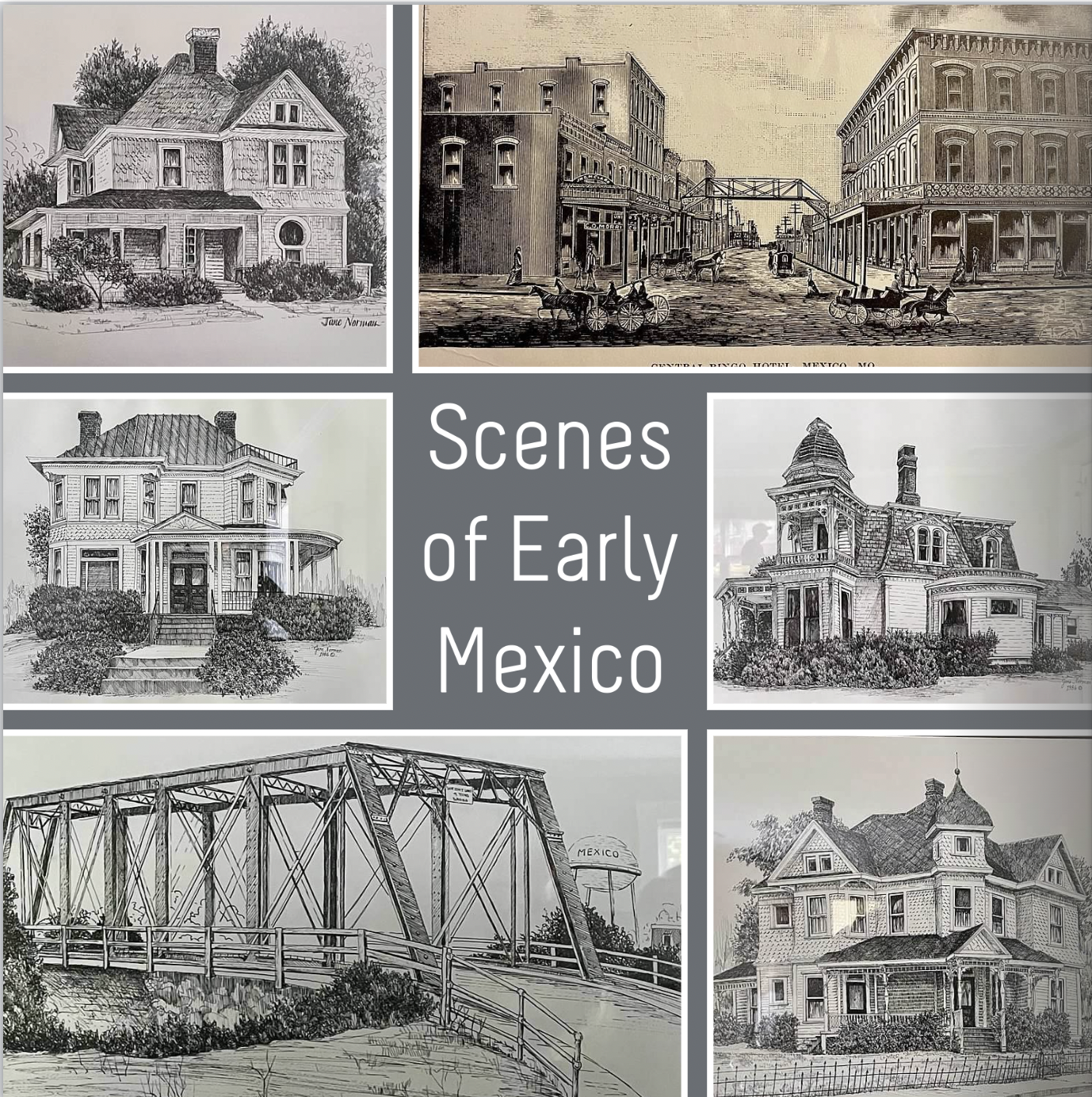
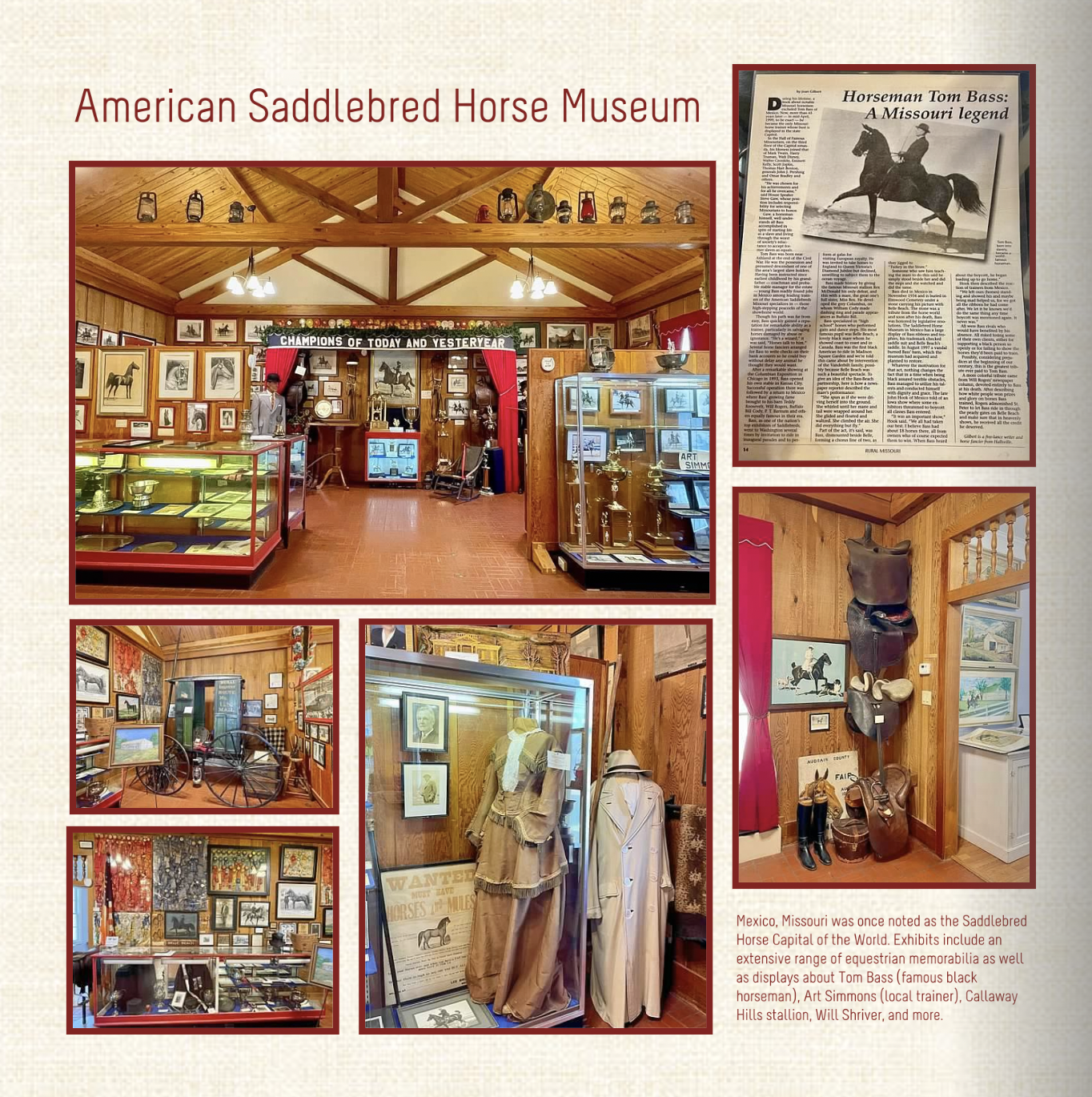
At the museum, we viewed photos of more early buildings that Frank and Nora likely saw in Mexico (shown above), and learned more about the Saddlebred Horses that played a large role in Mexico’s history (shown below). According to the book Images in America: Mexico (2010), by Vicki Berger Erwin, "Mexico was home not only to great horses, but to great trainers as well. The door to George and Will Lee's Lee Brother Stable on Western Boulevard is said to have had more champion show horses (and trainers) pass through it than any other barn in the country." The stables were eventually purchased by Art Simmons, who had a 60-year career in horses, and became known as Simmons Stables.


I know from their honeymoon photos that Frank and Nora enjoyed riding horses, as they rode them in both Seattle’s Washington Park and at Yellowstone National Park. So, perhaps they enjoyed riding in Mexico – or, perhaps they enjoyed watching the horse competitions that were a popular attraction. The American Saddlebred Horse Museum is another part of the Graceland Museum Complex. Mexico was once noted as the Saddlebred Horse Capital of the World. Museum exhibits include an extensive range of equestrian memorabilia as well as displays about Tom Bass (a famous black horseman), Art Simmons (a local trainer), the Callaway Hills stallion Will Shriver, and more. 


While I cannot be sure whether Frank and Nora had anything to do with saddlebred horses, I do know that after graduating from A.T. Still University’s College of Osteopathy in Kirksville, Missouri (see Blog Post #3), Frank set up his medical office and residence at 120 W. Promenade in downtown Mexico. So, why not return to Centralia, where most of his family lived? Mostly likely due to his potential clientele - Mexico’s population was significantly larger than Centralia’s at the time he was starting his medical practice – 5,099 vs. 1,722 (according to the 1900 Census). He must have been successful, for by 1903, he was serving as president of the Missouri Association of Osteopathic Physicians and Surgeons.


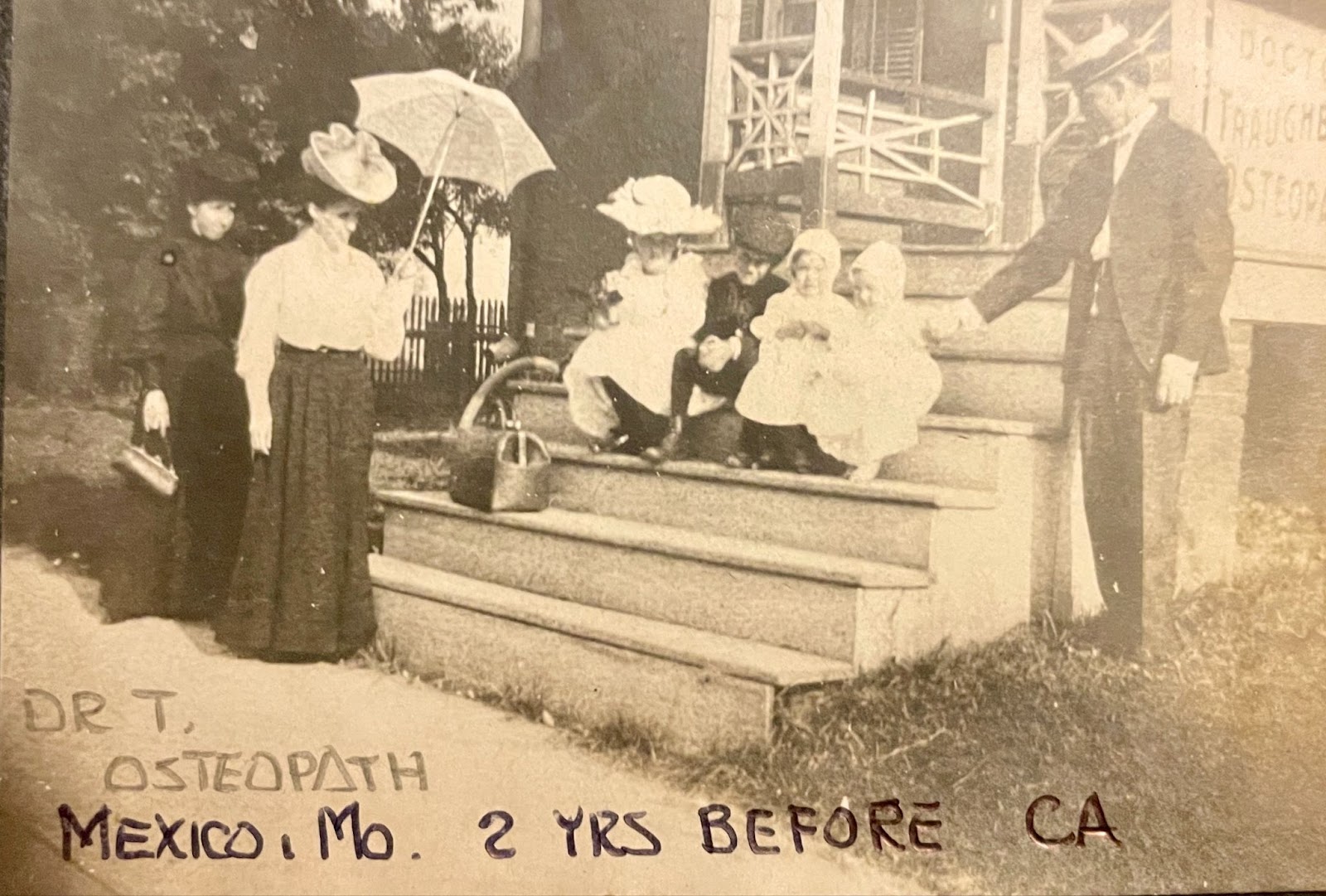
My father's printing appears on this photo, with identifying info about Dr. T


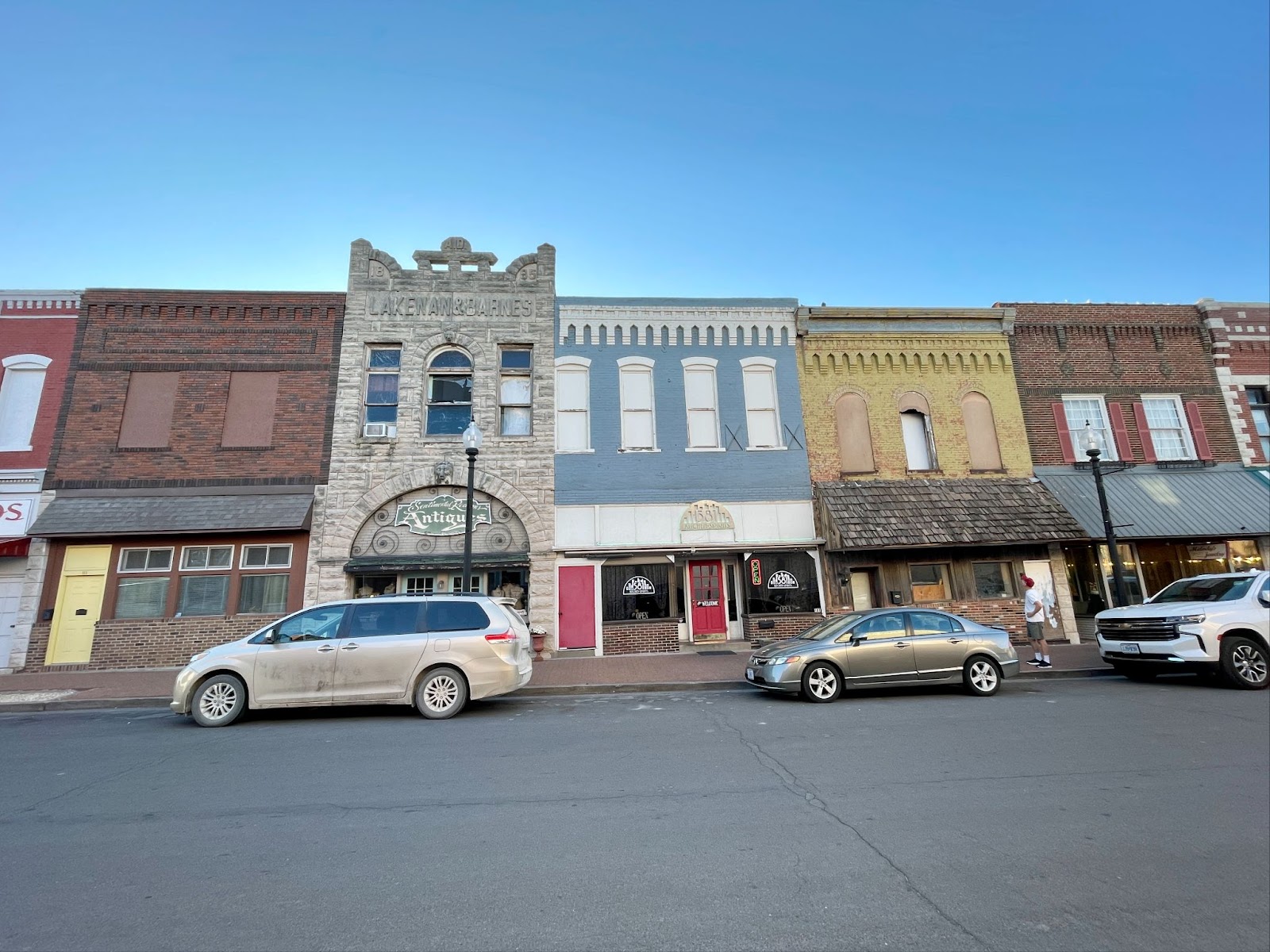
In the above photo, you can see “Doctor Traughber - Osteopath” written on the side of the building. I’m not sure who the two women and the four children are in the photo, but that’s Dr. Traughber standing on the right. He had three older and two younger sisters living in the area, as well as quite a few nieces and nephews, so it is likely some of them can be seen here. Mike and I went looking for the office, but all we could see at that address was a warehouse and an area under construction. It looks like his office building no longer exists, but across the street many old buildings do still exist, so it's likely his office/residence looked something like the ones seen in this photo.


Older buildings in downtown Mexico, near where Dr. Traughber’s office was located

From the photos in their album, it is clear Frank and Nora spent time visiting the Centralia relatives. One sad event I noticed in looking more closely at the Traughber family tree is that Frank’s brother Leslie died in November 1905 - just two months after he and Nora arrived in Mexico. Perhaps the woman in black in the office photo above is Leslie’s wife, Blanche. His death likely contributed to Frank and Nora’s decision to name their first son, born in July 1906, Francis “Frank” Leslie Traughber. Interestingly, Leslie and Blanche named one of their daughters (born in 1903) Nora - perhaps their future sister-in-law had already won their hearts! Little Nora may be one of the small girls sitting on the right in the office photo, and perhaps her brother Lowell (born in 1898) is seated second from the left. 


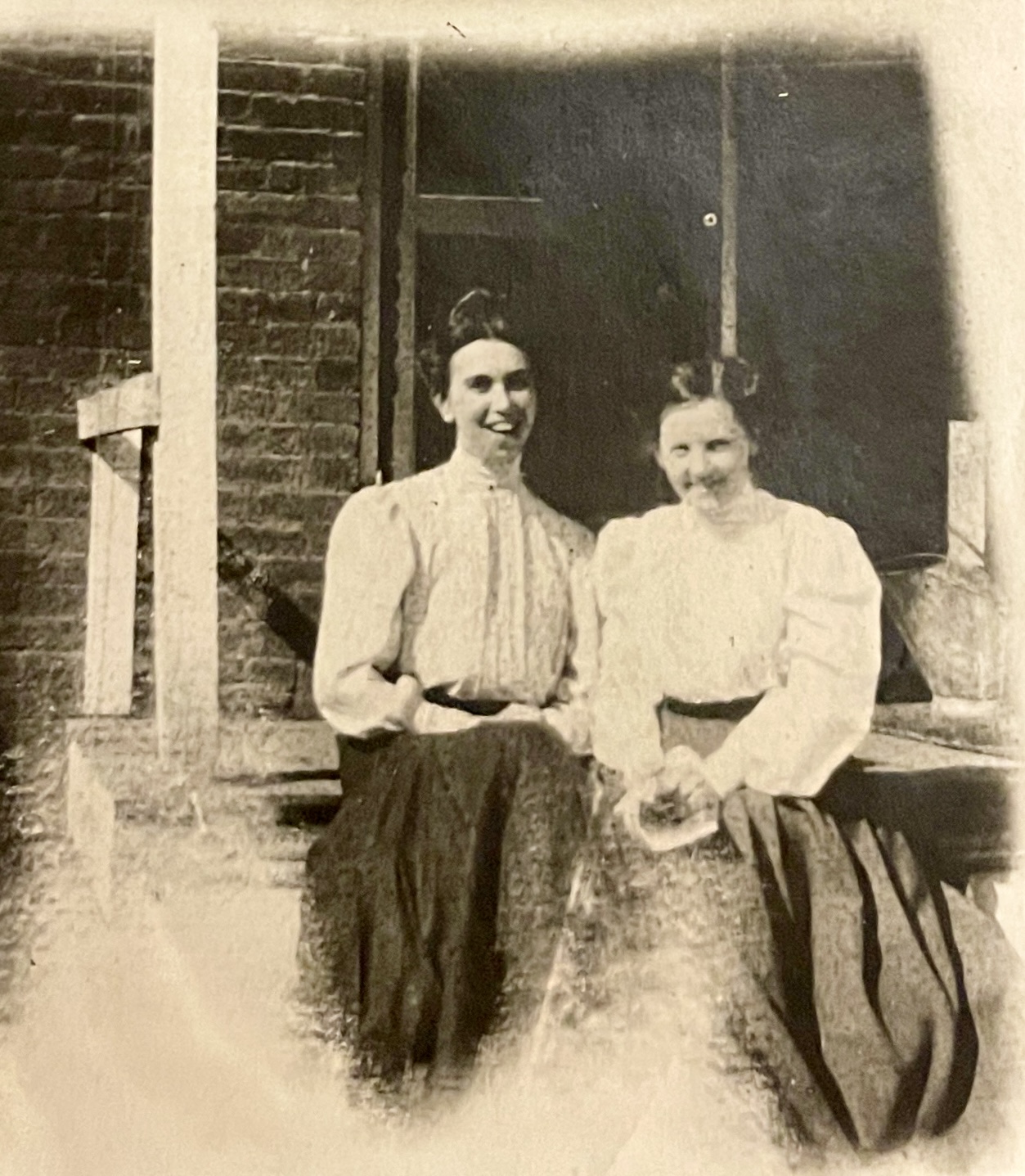
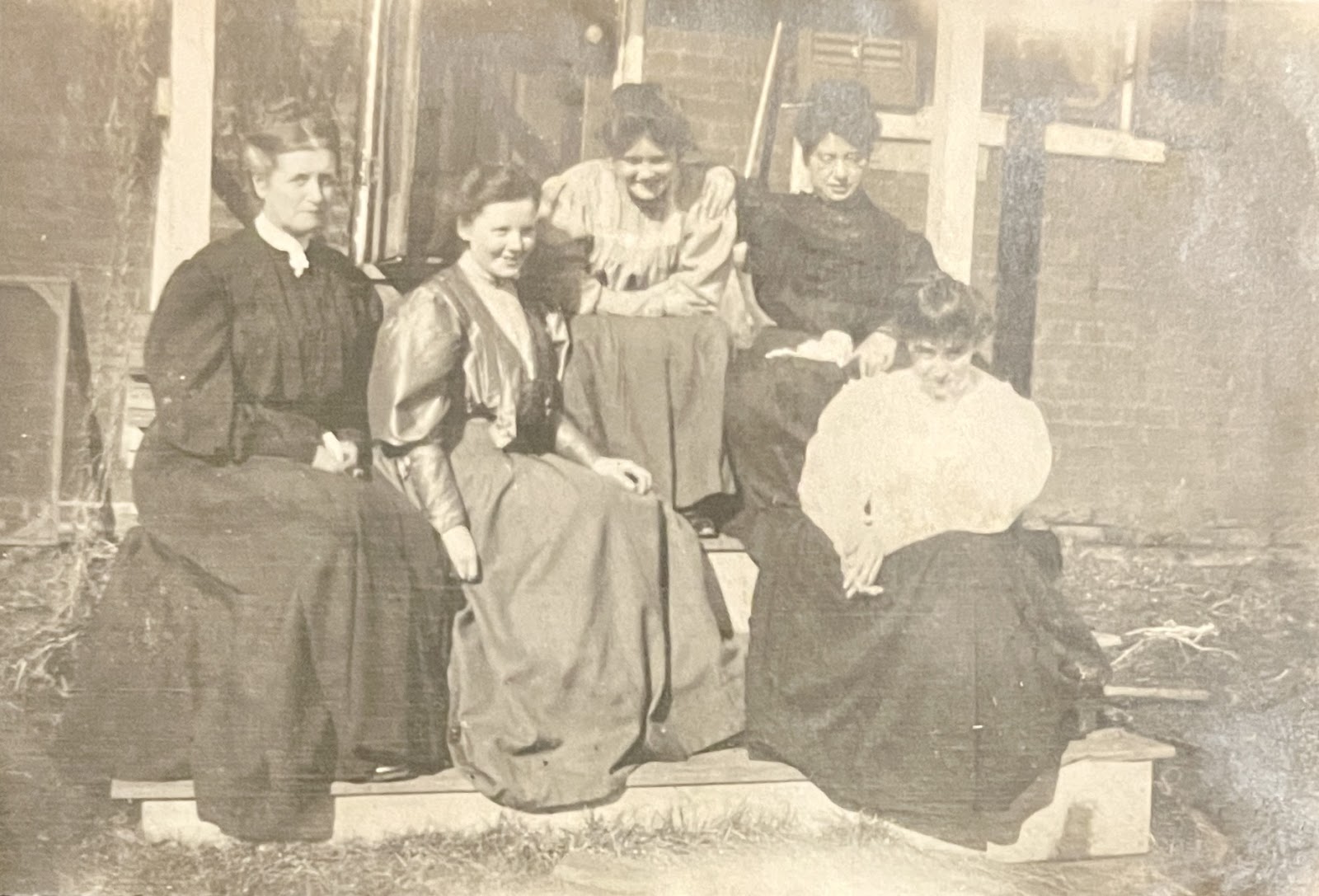
The album page at the top of this post includes photos of Frank’s parents (my great-great grandparents), as well as his sisters, though I don’t see any of his brothers or brothers-in-law. Some of the photos can be viewed more closer up below. I especially like the one of Frank and his mother. Frank’s siblings included:


Sisters:

  • Stella Lee Traughber (1869-1919) + William A. Johnson
  • Hattie Belle Traughber (1870-1941) + John Lewis Skaggs
  • Elizabeth “Lizzie” Traughber (1873-1943)
  • Ida Lou Traughber (1880-1969)
  • Myrtle Francis “Fannie” Traughber (1882-1981) + Dr. Charles William Bryson

Brothers:

  • Leslie Bryson Traughber (1877-1905) + Lola Blanche Rowland
  • Charles Weaver “Carl” Traughber (1886-1965) + Georgia Alice Powell
  • George Burnett “Bernie” Traughber (1889-1966) + Hallie Glenn McCabe

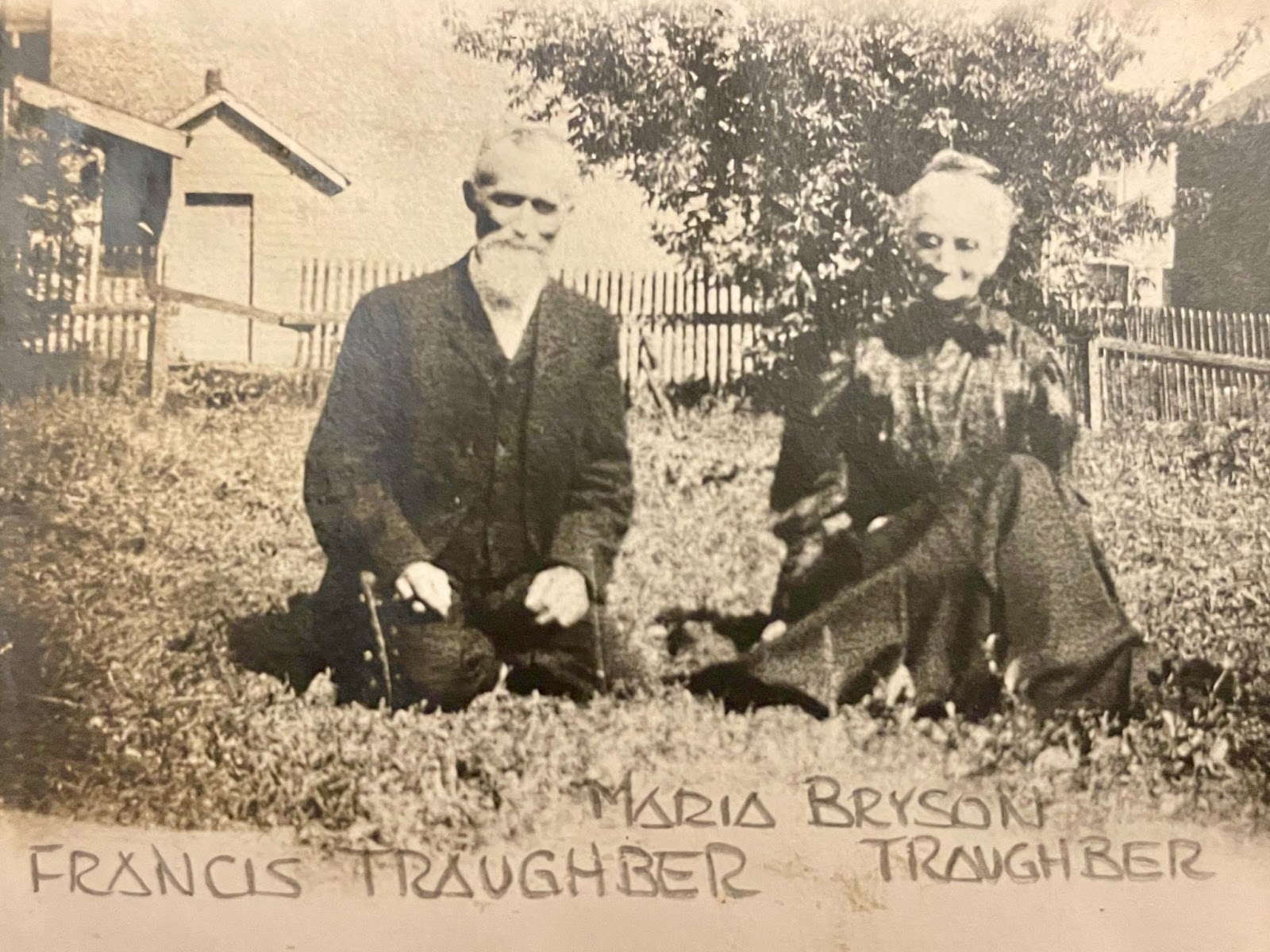
My great-great grandparents, Francis Marion Traughber (1848-1931)

and Mariah “Marnie” Agnes Bryson Traughber (1849-1927)


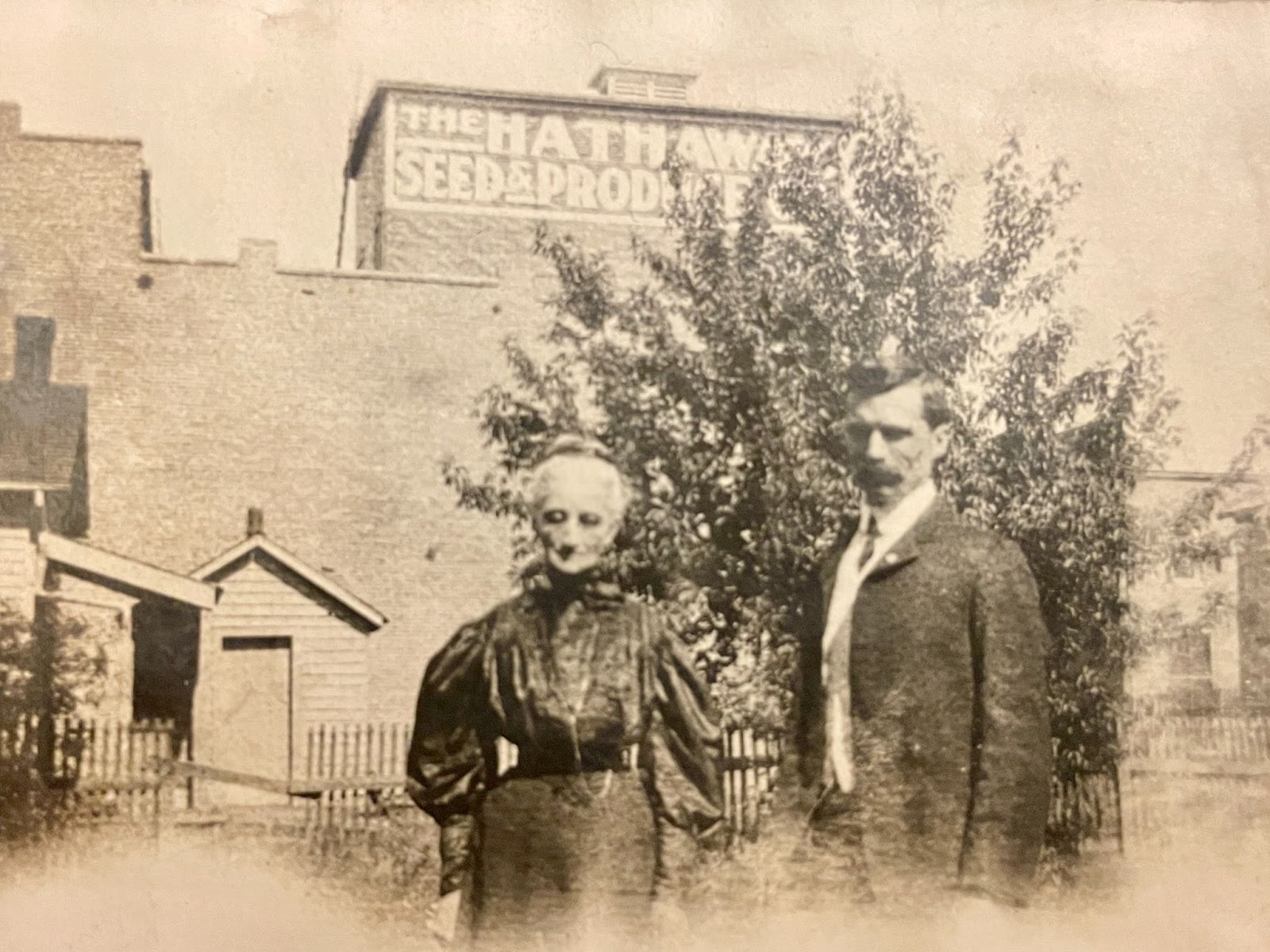
Frank with his mother in front of the Hathaway Seed & Produce Co.


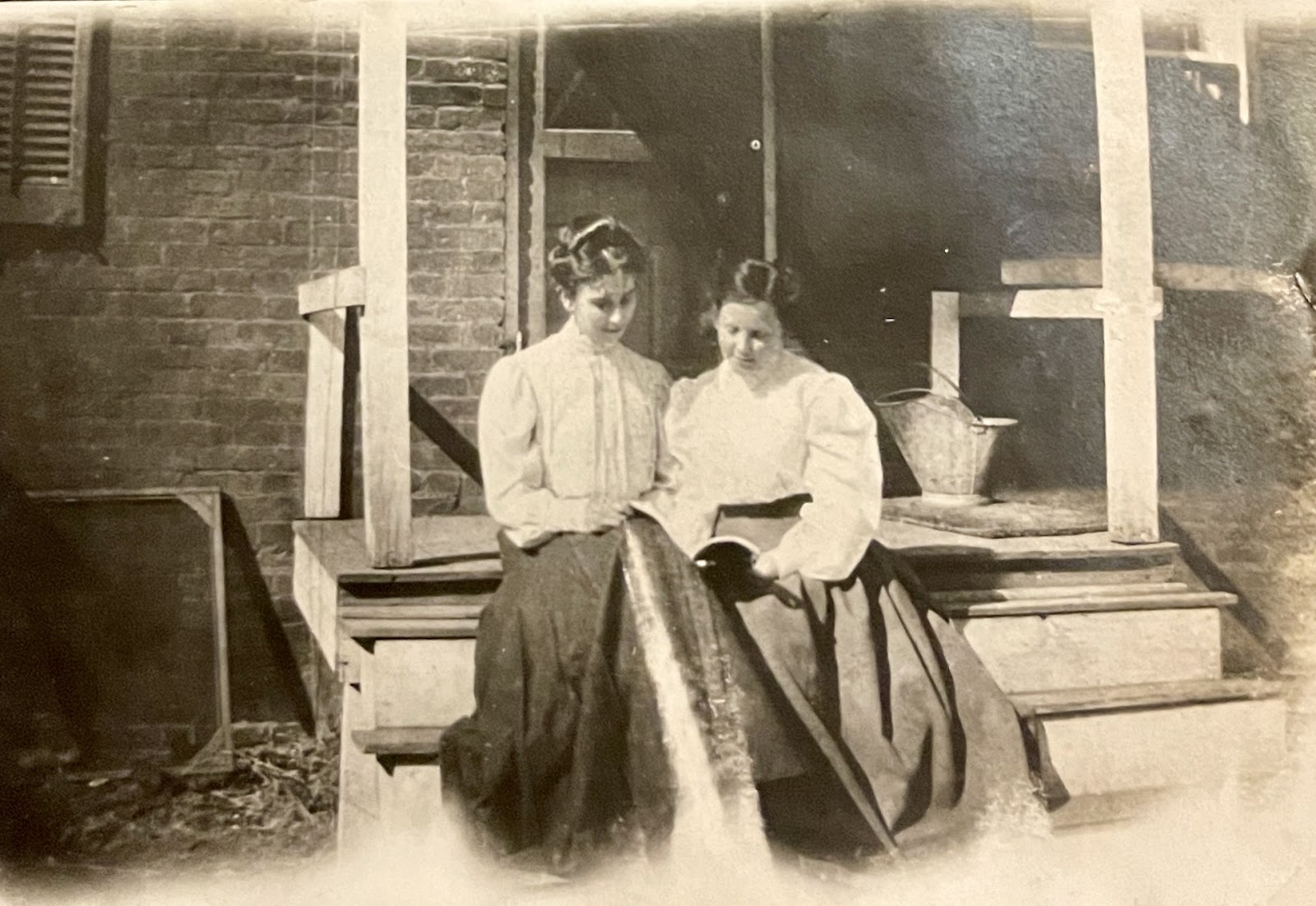
Nora (on the right) showing a book to one of the Traughber sisters


The two of them smiling for the camera


A group of the Traughber women (Nora is seated second from left)


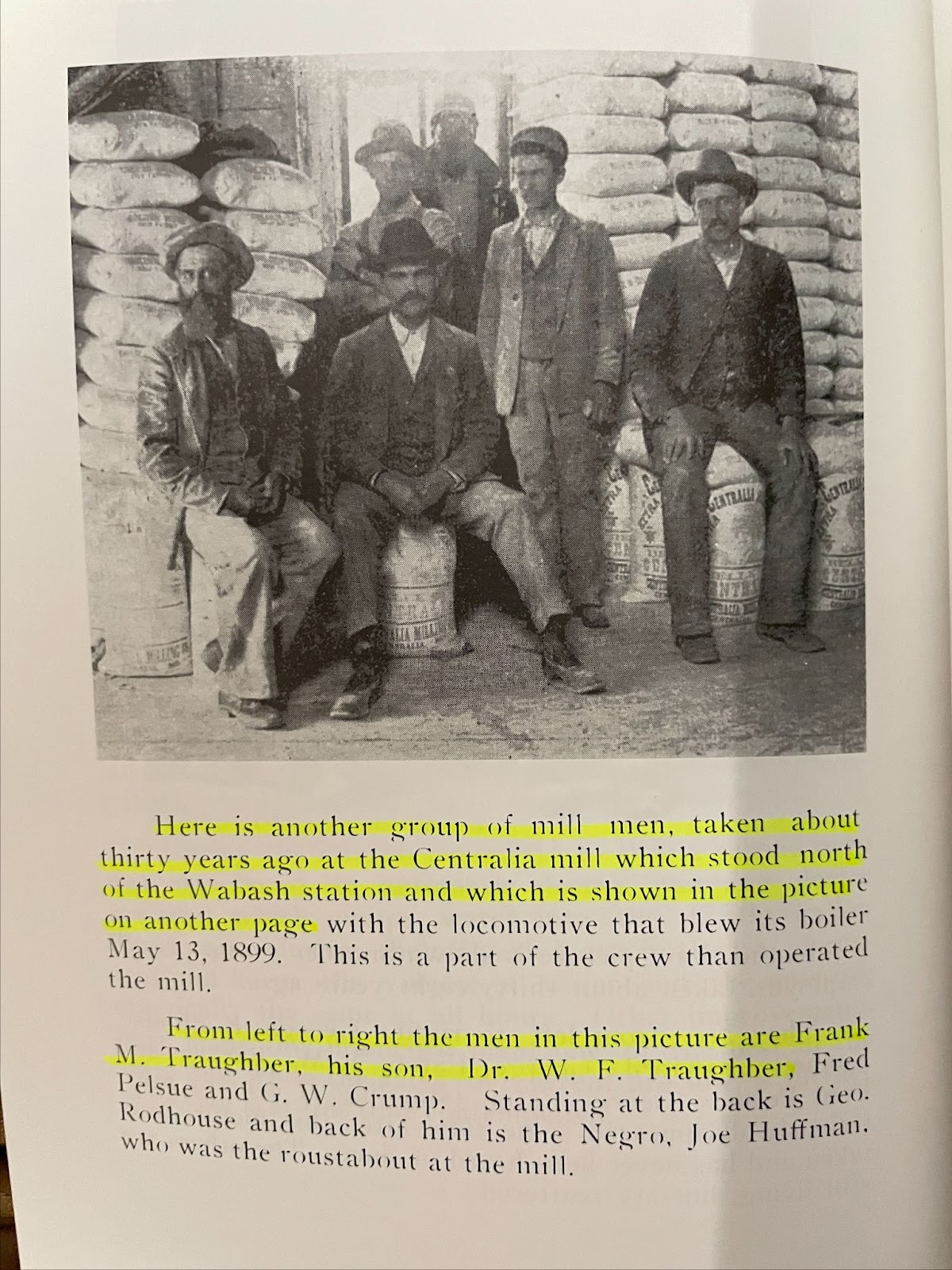
While in Mexico, I also learned that Frank sometimes helped out his father at the Centralia Mill, which his father partially owned. I found the following photo of father and son in a book titled History of Centralia, Missouri, written by Edgar T. Rodemyre and published in 1936. It said the photo was taken about thirty years earlier.


A page from the 1936 book History of Centralia, Missouri


That seems, though, like a story for another day - not really related to this series on Frank and Nora's historic honeymoon trek. In a future post, I will share more of what I learned during our recent visit about the Traughbers' lives in Centralia. In the meantime, thanks for following along on their amazing adventure!


Following in My Great-Grandparents’ Footsteps: An Afternoon at Strawberry Hill in Golden Gate Park

Chasing History: Exploring My Ancestral Roots - Blog Post #59 By Tonya McQuade We enjoyed the views as we hiked to the top of Strawberry Hi...