Friday, September 27, 2024

A Historic Trek: The Amazing Honeymoon of W.F. Traughber and Nora Petree Traughber in 1905, Part I


Chasing History: Exploring My Ancestral Roots - Blog Post #42
By Tonya McQuade

The first stop on Frank & Nora Traughber’s Honeymoon - Hotel Del Monte,

Del Monte (Monterey), California [1]


In my last post, I wrote about my great grandparents’ wedding in San Jose, CA. William Francis “Frank” Traughber and Nora Elma Petree were married August 17, 1905, at the home of Nora’s brother Louis and his wife Kittie. Following the wedding, the two set off on quite an adventure. Recently, my father gave me their old photo album with pictures from their honeymoon, as well as their early years of marriage and family life. I decided I wanted to try to map out their journey and learn more about their adventures.


Nora’s description on the back of one photo, tucked loosely into the album, gave me a great starting point. The photo, taken at Del Monte in modern-day Monterey in 1905, states: “Figuring on our trip, which took us to Los Angeles, Catalina, and all about in So. Calif., to Portland World’s Fair of 1905, on to Seattle, Yellowstone Park, Salt Lake City, Missoula Montana, and several other stops before we arrived to Mexico, MO, where we lived for 2 years before coming to Calif. via San Jose on to Los Angeles.”
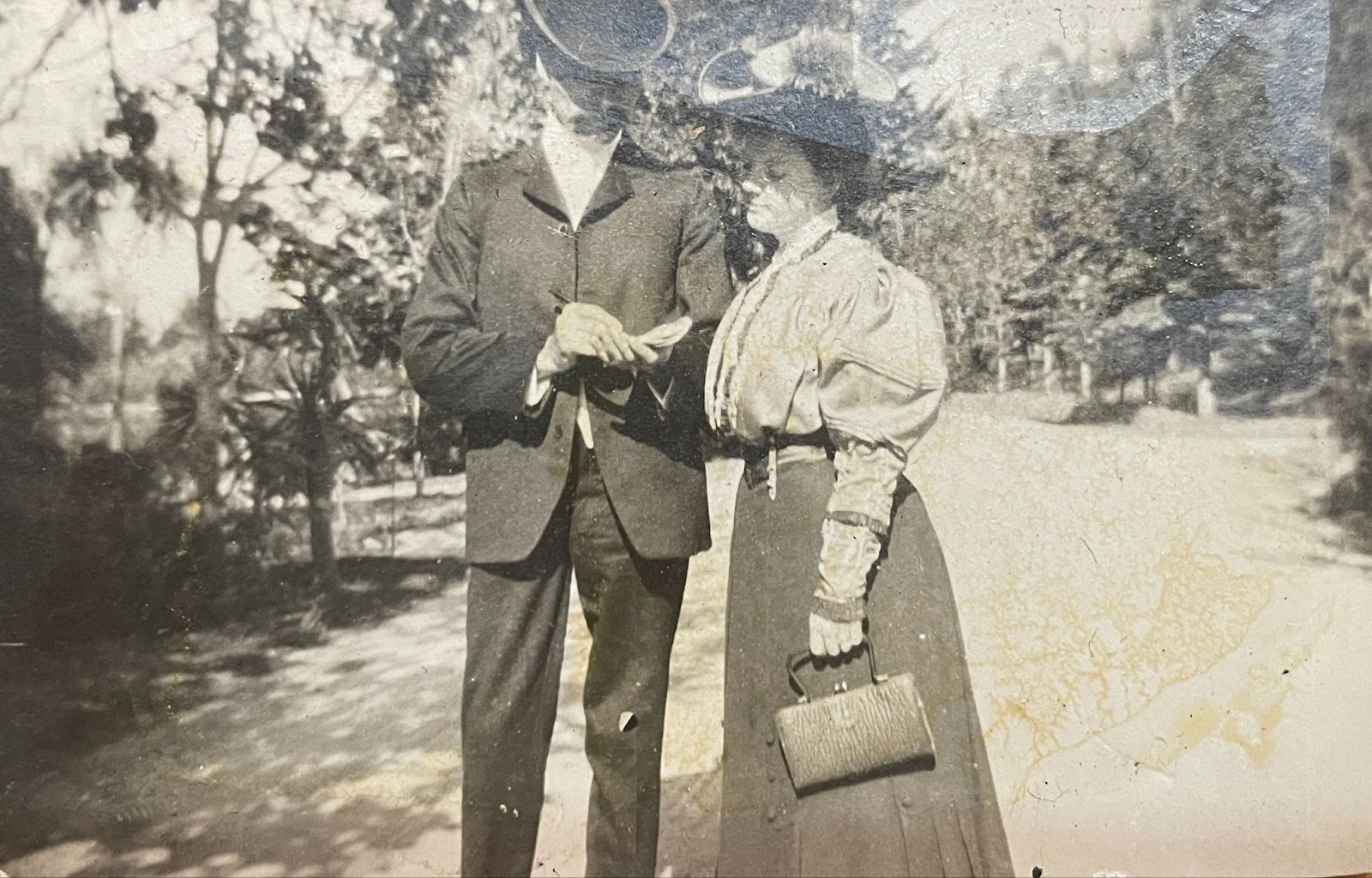

In the album, this photo is labeled, “Figuring to see how long we can stay.” A second copy of the photo, loosely tucked in the album, has the inscription written below.


As it turned out, their honeymoon lasted for about four weeks - which seems like quite an adventure for the time period! They traveled by train, boat, horse, and wagonette/rig, from what I can tell. Here’s the timeline I worked out from the album pages where Nora wrote dates - for some places, dates are missing:


Traughber Honeymoon Trip: 1905


Aug 17 - Wedding in San Jose

Aug 18 - Del Monte, CA (modern-day Pebble Beach in Monterey)

Aug 19 - Pacific Grove

Aug 20 - Santa Cruz Big Trees

Aug 22 - Catalina Island

Aug 25 - San Jose

Aug 26 - San Francisco

Unknown - Shasta Springs/Mt. Shasta

Unknown - Portland, Oregon’s “Lewis and Clark Centennial” World’s Fair 

Aug 30 - Tacoma, Washington

Aug 31 - Seattle, Washington 

Sept 4-9 - Yellowstone Nat’l Park

Unknown - Missoula, Montana

Unknown - Salt Lake City, Utah

Mid-Sept - Mexico, Missouri (to begin their new life)


The album also includes labels for many of the photos, often written in a very playful way - especially the early pages. The labels are beautifully scripted by Nora in white pen. Frank and Nora must have had a photographer following them around in Del Monte right after the wedding to take many of the photos they were able to capture. Here’s a sampling of a couple pages, with the labels printed below the photos:


Captions: Del Monte, Cal. Aug 18, 1905

Off for a stroll. / The flower garden. / “Do not pull these flowers.”

What if they find it out? / We just can’t leave here. / If it wasn’t chained.
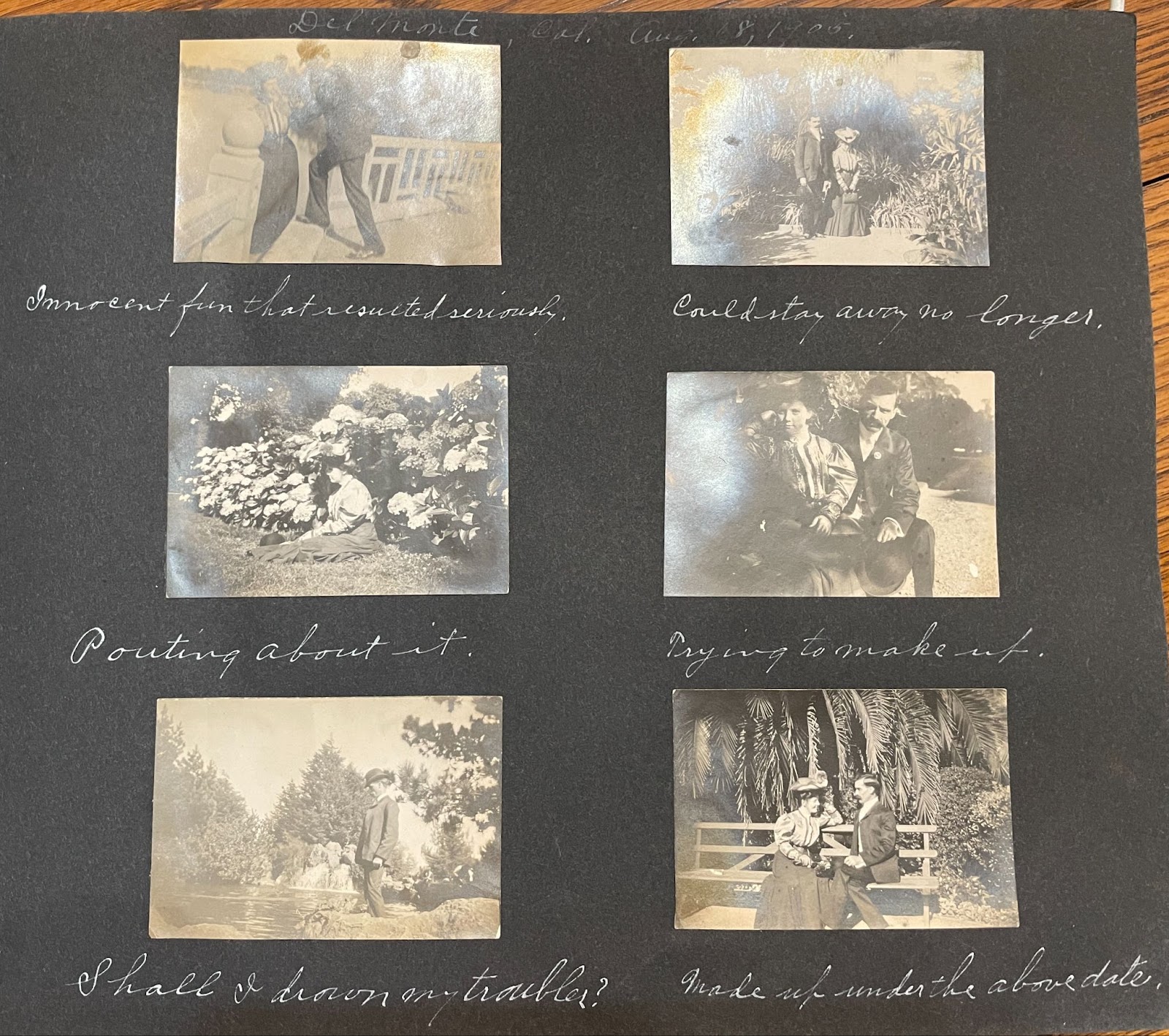

Captions: Del Monte, Cal. Aug. 18, 1905

Innocent fun that resulted seriously. / Pouting about it. / Shall I drown my troubles?
Could stay away no longer. / Trying to make up. / Made up under the above date.


I love how they tell a story, both through the photos and the captions. The many pages of photos from Del Monte got me wondering, though, where Del Monte was located. After a bit of research, I learned that part of its original grounds now make up Pebble Beach Golf Course in Monterey. The hotel where they stayed, Hotel Del Monte, was a famous resort and tourist attraction.


This OLD VIDEO from 1897 shows a party of tourists arriving at the Hotel Del Monte in a series of carriages. Frank and Nora likely did the same, after first traveling from San Jose to Monterey on the Del Monte Express, a passenger train operated by Southern Pacific Railroad from 1889-1971 that ran from San Francisco to San Jose, then on to the “Del Monte” stop in Monterey.


The Hotel Del Monte, which sat on 126 acres of cultivated ground on the Monterey peninsula, was located near this stop. Opened in 1880, the hotel was advertised as being “in every detail and in all its environment ideally Californian.” The ad below additionally claims it has “the most magnificent hotel, the most expansive landscape, the most varied forests, the most delightful temperature, and the most superb flowers IN ALL AMERICA.” That’s quite a claim!


Advertisement for the Hotel Del Monte in Sunset magazine [2]


I’m not sure whether Frank and Nora were lured by an ad like this, or whether Nora during her years at Stanford University had heard about the hotel and added it then to her honeymoon wishlist. Perhaps they had read the May 1898 inaugural issue of Sunset magazine, which featured a seven-page illustrated section promoting “Summer Holidays Among the Hills: Santa Cruz Mountains and Shasta Resorts.” That first issue only cost 5 cents and included no outside advertisements “under the assumption and hope that subscriptions and self-promotion would cover all costs." [3]


Published by the Passenger Department of the Southern Pacific Company in order to promote western tourist destinations, Sunset magazine took its name from the railroad's much-touted Sunset Route, which ran between Los Angeles and New Orleans. The Sunset Route “offer[ed] special inducements to winter travelers, by reason of its southern route, thereby avoiding the extreme cold of the winter months. Its course [lay] through a section of the country that present[ed] a variety of beautiful and picturesque natural scenery. It [was] also the direct route to the popular resorts of Southern California, thereby making it a favorable route for tourists.” [4] Monterey and Santa Cruz soon became other favorite destinations. Click here to see an old video of the train.


Photo of Hotel Del Monte. Detroit Publishing Co, 1899. Library of Congress. [5]


Whatever the case, Frank and Nora made the Hotel Del Monte their first honeymoon stop - and they definitely seem to have taken advantage of many of its offerings while they were there. Their album includes photos of them sitting under the pines, firs, live oak, and giant date palm; strolling in the flower garden and the Arizona Garden; enjoying the Lover’s Driveway and hotel’s back porch; finding their way through the Mystic Maze; and sitting in a boat at the water’s edge.


Under the “Giant Date Palm” at Hotel Del Monte - perhaps the same one as in the

historic photo of the hotel above.


Strolling in the flower garden - and being tempted to pick some flowers!


The album includes two photos of Frank and Nora in the Arizona Garden. As it turns out, there is a lot of information about this garden. It was designed by the noted nineteenth century landscape gardener Rudolph Ulrich and included a combination of desert and subtropical plants. Ulrich also designed Arizona Gardens for Stanford University and San Francioco’s Golden Gate Park, but his first was the garden at the Hotel del Monte. It’s likely that Nora enjoyed the Arizona Garden at Stanford while she was a student there. 


The Hotel Del Monte, established in 1880 by railroad baron Charles Crocker through the Southern Pacific Railroad's property division, Pacific Improvement Company, soon became a playground for the rich and famous, as well as the wealthy and influential. The hotel's property "extended south and southeast of the hotel and included gardens, parkland, polo grounds, a race track, and a golf course. Originally used for hunting and other outdoor activities, the hotel's property became Pebble Beach, an unincorporated resort community, and the world-famous Pebble Beach Golf Links. The famous 17-Mile Drive was designed as a local excursion for visitors to the Del Monte to take in the historic sights of Monterey and Pacific Grove and the scenery of what would become Pebble Beach." [6]


The hotel was “justly renowned for its extensive and beautiful grounds….  Ulrich was particularly known for creating extravagant formal landscapes, comprising  both native and exotic plants. He utilized a gardenesque style for many of his estate and hotel designs, displaying diverse botanical specimens in large areas of velvety turf. He used fountains, urns, and statuary as focal points in his landscapes, and often included artificial lakes and hedge mazes as additional design elements.” [7] 
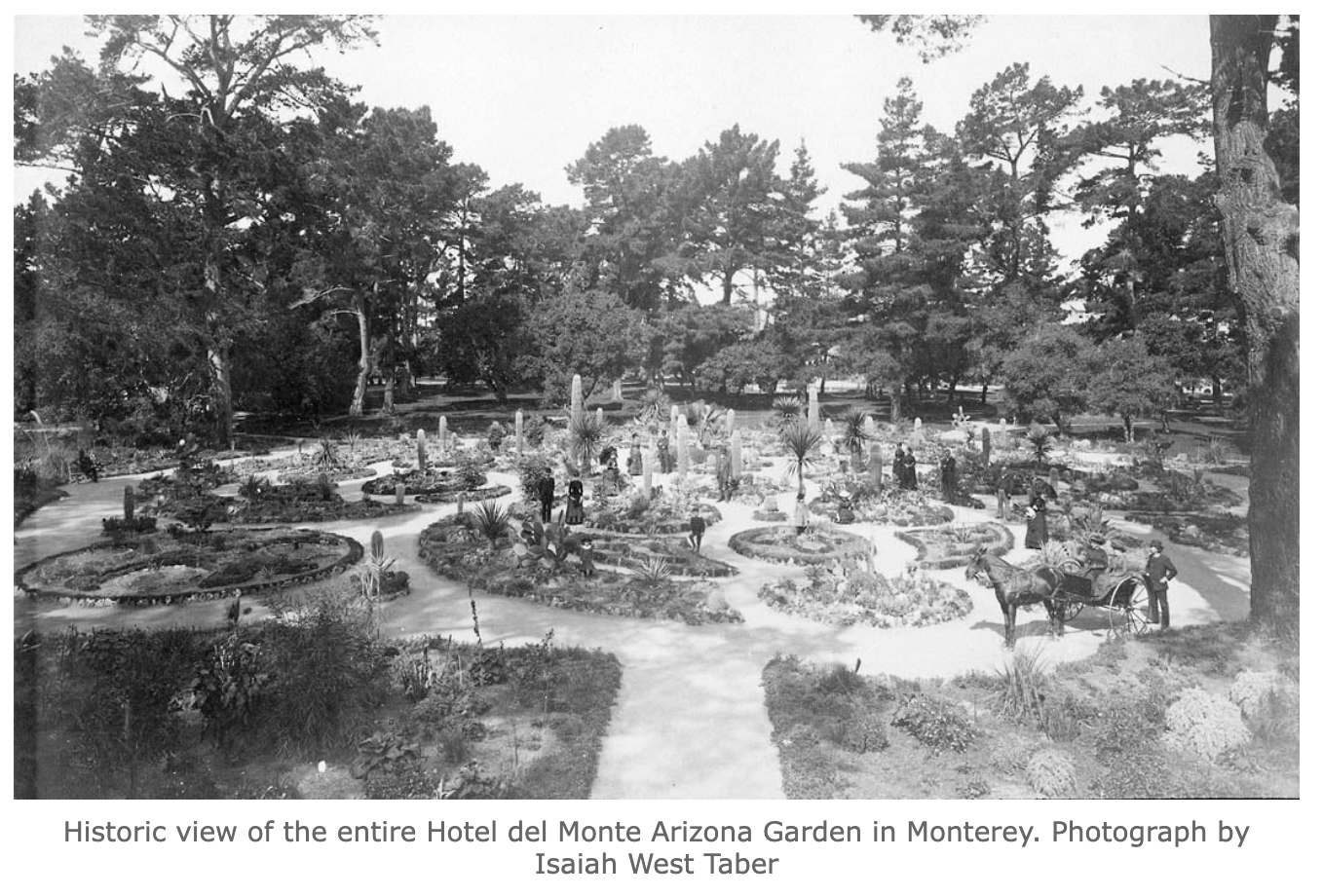


Ulrich’s efforts were described in a Monterey newspaper on November 3, 1881, as follows:

“Mr. Ulrich, the head gardener at the Hotel del Monte, returned on Wednesday last from a trip to Mexico, where he has been to purchase plants indigenous to that country. One carload of cactus and other tropical plants have already arrived and three more are expected next week. The plants gathered on this trip (and others like it) were used to create what Ulrich called an ‘Arizona garden.’ To obtain as many plants as he needed to generously fill the garden, he had been given the use of a locomotive and several boxcars, along with a crew of eight men and six teams of horses. He made his way by rail to the Arizona Territory and farther south into Mexico, where he collected and purchased plants of the Sonoran Desert.” [8]


Ulrich’s Arizona Garden consisted of “a complex series of fifty-seven raised beds in four symmetrical quadrants radiating around one large central bed…. In addition to over sixty species of cacti, the garden was planted with numerous other succulents (notably agaves, aloes, and yuccas), palms, conifers, ornamental grasses, and flowers. Two Victorian classics, monkey puzzle trees (Araucaria araucana) and pampas grass (Cortaderia selloana), featured prominently in several beds.” [9]
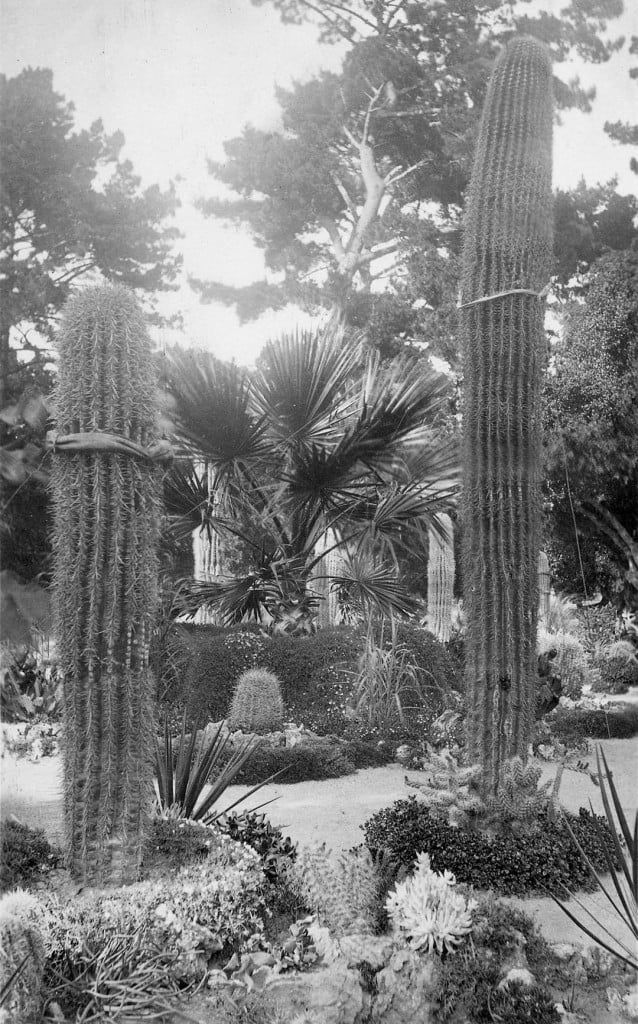

 Tall columnar saguaro cactus (Carnegiea gigantea) were a signature of the original Hotel del Monte Arizona Garden in Monterey. Photograph by CWJ Johnson

Tall columnar saguaro cactus (Carnegiea gigantea) were a signature of the original Hotel del Monte Arizona Garden in Monterey. Photograph by CWJ Johnson. [10]


“The garden caused a great sensation once it was planted, and was featured prominently in Hotel del Monte literature and marketing. Hotel pamphlets pointed out with great pride that the Arizona Garden was not “under glass” as it would need to have been in the eastern United States; this was proof, indeed, of California’s “superior” climate. The large size of the garden (30,625 square feet), the variety and rarity of the plants, and the use of formal design was absolutely unique in California at the time. Guests of the hotel came from all parts of the United States, as well as England and Europe, and were suitably impressed by this seaside desert garden, often posing for photographs amongst the plants….


The Arizona Gardens, Del Monte, Monterey, Cal., American Stereoscopic Co., 1902 [11]


“The site he chose (southwest of the hotel) was not close to the main building, but could only be glimpsed from the veranda through the surrounding trees and shrubbery. Whether he deliberately sited this most unusual garden as one might a magnificent rose garden—behind a hedge or around the corner, as a prize to be discovered by the more intrepid hotel guests—is open to conjecture. The positioning of a hedge maze, another popular landscape feature of the day, in the exact opposite area of the grounds (southeast of the hotel) makes it seem likely that both of these horticultural curiosities were placed by Ulrich for optimum effect.” [12]


The “hedge maze” mentioned above is another feature of the hotel that Frank and Nora enjoyed. Called the “Mystic Maze,” the maze was a large ornate shrubbery on the grounds of the Hotel Del Monte. I found several photos online that matched the photo of Frank and Nora at the entrance.


Entrance to the Mystic Maze

Photo of the Maze at Hotel Del Monte [13]


An interior view of the Mystic Maze [14]


Interestingly, the same month that Frank and Nora honeymooned in Monterey and Santa Cruz, Sunset magazine featured a cover photo of a Santa Cruz beach. Its caption read, "A mother walks her baby boy up off the beach; in the background, happy bathers cavort in the surf. The boy is carrying a nice stalk of dead kelp." [15]


Cover of Sunset magazine - August 1905


When Frank and Nora visited Hotel Del Monte, it was already well established as one of the premier tourist destinations on the West Coast. Pacific Improvement Company – headed by Crocker, as well as fellow railroad barons Leland Stanford, Collis Potter Huntington, and Mark Hopkins, Jr. – had opened the scenic 17-Mile Drive along the majestic Monterey coast in 1881, and by 1901, they had begun charging a 25 cent toll per person  (today admission is $12 per vehicle). In those early days, the drive began and ended at the Hotel Del Monte.


In 1897, “Del Monte Golf Course opened as a 9-hole golf course, making it the oldest golf course west of the Mississippi still on its original site. In 1903, it was made into an 18-hole golf course.” [16] In 1909, a lodge opened to serve meals to travelers on the 17-mile drive. For more information about how the Del Monte Golf Course, the Lodge, and Pebble Beach Golf Course evolved, check out this timeline.


I’m not sure whether Frank and Nora rode along the 17-mile drive, but their album includes photos or them on “the surf beaten rocks” and “the rocky way” in Pacific Grove, looking at children “bathing in the surf,” and standing among “the big trees [in] Santa Cruz” on August 20, 1905, so they clearly ventured out from the Hotel Del Monte while staying on the Monterey Coast. It's possible they visited Big Basin Redwoods, which was established in 1902 and is California's oldest state park. Some of its ancient coast redwoods are more than 50 feet around and up to 1800 years old. The tallest tree, "Mother of the Forest," is 329 feet tall.  


“On the surf beaten rocks” and watching children “bathing in the surf” in Pacific Grove, near Monterey in California


Today, guests can still visit the Hotel Del Monte, but it now serves as the Naval Postgraduate School. As I discovered online, “The Hotel Del Monte was requisitioned by the Navy at the beginning of World War II and used as a pre-flight training school. In 1947, the U.S. Navy purchased the hotel and its surrounding 627 acres for $2.5 million. In 1951, the United States Naval Academy's postgraduate school moved from Annapolis, Maryland to its new location—the former Hotel del Monte." [17]


According to the Naval Postgraduate School website, “Whether your stay is for business or pleasure, we know you will enjoy the ambiance and heritage of the Hotel Del Monte. Hotel Del Monte, under the direction of the CNIC and the Fleet and Family Readiness Program, is the Navy's 5-Star Hospitality program. Hotel Del Monte offers standard rooms and suites that are fully modern and comfortable, as well as four luxurious, custom-decorated Admiral Suites for distinguished visitors.” [18]


I know I’m curious. I think I’ll try to check it out the next time I’m in Monterey! In the meantime, since this post is definitely long enough, tune in next time for Part II of the Traughber Honeymoon saga!
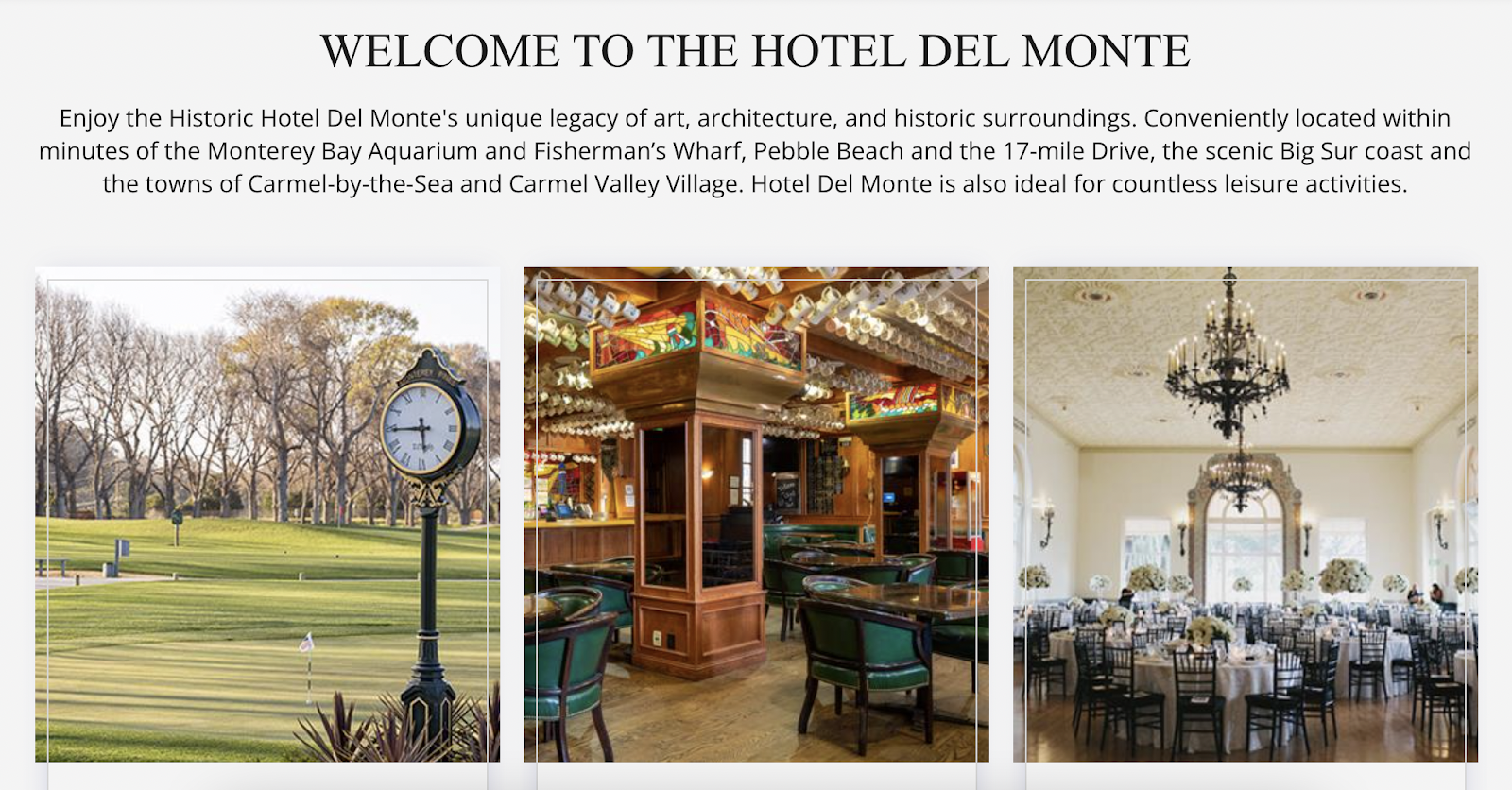

An advertisement for today’s Hotel Del Monte, now operated by Naval Support

Activity Monterey [19]


Endnotes:

  1. Jackson, William Henry. “Hotel del Monte, Del Monte [ie. Monterey], California.” Detroit Publishing Co., 1906. https://www.loc.gov/resource/det.4a31560/.
  2. Whaley, Derek. “Curiosities: Sunset Magazine.” Santa Cruz Trains, 8 November 2019, https://www.santacruztrains.com/2019/11/curiosities-sunset-magazine.html.
  3. Whaley, Derek. “Curiosities: Sunset Magazine.” Santa Cruz Trains, 8 November 2019, https://www.santacruztrains.com/2019/11/curiosities-sunset-magazine.html.
  4. White, James H. “Hotel Del Monte.” Edison Manufacturing Co., 1897. https://hdl.loc.gov/loc.mbrsmi/ntscrm.00047177.
  5. “Hotel Del Monte, Cal.” Detroit Publishing Co., c1899, https://www.loc.gov/resource/det.4a32216/.
  6. “Hotel Del Monte.” Wikipedia, https://en.wikipedia.org/wiki/Hotel_Del_Monte.
  7. Biklé, Anne, and Frederick Law Olmsted. “Rudolph Ulrich's Arizona Gardens.” Pacific Horticulture, https://pacifichorticulture.org/articles/rudolph-ulrichs-arizona-gardens/.
  8. Ibid.
  9. Ibid.
  10. Ibid.
  11. “The Arizona Gardens, Del Monte, Monterey, Cal.” American Stereoscopic Company, 1902, https://www.loc.gov/resource/stereo.1s10387/.
  12. Biklé, Anne, and Frederick Law Olmsted. “Rudolph Ulrich's Arizona Gardens.” Pacific Horticulture, https://pacifichorticulture.org/articles/rudolph-ulrichs-arizona-gardens/.
  13. The Maze at Hotel Del Monte, Monterey, Cal.” John and Jane Adams Postcards, M. Reider, https://digitalcollections.sdsu.edu/do/3f5929f2-f6cc-44dc-a7f3-ba9cb31e4475.
  14. Heidrick, A. C. “Mystic Maze in Del Monte grounds, California.” Baja California and the West Postcard Collection. MSS 235. Special Collections & Archives, UC San Diego, https://calisphere.org/item/ark:/20775/bb56351442/.
  15. Whaley, Derek. “Curiosities: Sunset Magazine.” Santa Cruz Trains, 8 November 2019, https://www.santacruztrains.com/2019/11/curiosities-sunset-magazine.html.
  16. Graham, Julian P. “The Story of Pebble Beach Resorts | Heritage and Timeline.” Pebble Beach Resorts, https://www.pebblebeach.com/timeline/.
  17. “Hotel Del Monte.” Wikipedia, https://en.wikipedia.org/wiki/Hotel_Del_Monte.
  18. “Welcome - Hotel Del Monte.” Naval Postgraduate School, https://nps.edu/web/navy-gateway.
  19. Hotel Del Monte, https://www.thehoteldelmonte.com/.


Monday, September 23, 2024

Exploring Family Connections to the Petree House in San Jose’s Naglee Park

Chasing History: Exploring My Ancestral Roots - Blog Post #41

By Tonya Graham McQuade


The historic Petree House - located at 102 S. 12th Street, San Jose, CA

Last month, I had the opportunity to run into an important piece of my family history once again. The unexpected “meet up” happened because my husband parked our car nearly in front of it when he came to pick me up from the San Jose Woman’s Club, located at 75 S. 11th Street, in downtown San Jose. I was there to participate in the “Chill Out and Read” book festival - and, as it turns out, the San Jose Woman’s Club is just one block from the home in Naglee Park where my great grandparents got married in 1905.


I first discovered the house sometime prior to 2008 while doing family history research. I knew my great grandparents, William Francis "Frank" Traughber and Nora Elma Petree, had been married at the home of Nora’s brother Louis Edward Petree, who was a San Jose attorney. I even had a photo of her in front of his house, as well as the newspaper story that described the wedding. However, I didn’t actually know where the house was until I found the address listed in an old San Jose Directory that had been put online. 


Upon further digging, I discovered the house, located at 102 S. 12th Street, was still known as the “Petree House” and had been built in 1903 for “an attorney who was one of the developers of what is now Los Altos” - aka. Louis Petree (1). Wow! He also helped to develop Los Altos! When I drove by to look, the house was still there. The color had changed, but I could see from the old photo I had that it was the same house.


Photo of the house back in 1905 with Nora standing on the porch


I waited until my father came to visit, though, to actually knock on the door. We met the couple who lived in the house, told them our connection to the original Petree owners, and showed them the old photos and news clipping we had; then, they let us take a quick look inside. They told us the house was sometimes included on historic house tours - and I made a note to check the newspaper for the next possible opportunity to get a fuller view of the house. I also later mailed them a copy of the photos and news article.


My father Doug Graham and I on the porch of the Petree House,

with his photo album in hand


How do I know this was prior to 2008? Because I later received a letter from the new owner, who took ownership in 2008 and let me know that the previous owners had shared the letter I had sent, along with copies of the news clipping and photos. He said that he and his wife “especially enjoyed the exterior picture of the house shortly after completion … [since their] goal with this property is to ring it back to its original glory, and having the photo for reference is a great asset.”


His letter, dated Nov. 2012, also informed me that the house had officially been listed as a San Jose Historic Landmark known as the Petree House on Jan. 1, 2010 (HL09-185). With the letter, he sent me a copy of the application he had prepared as part of the process to seek city landmark status. The application included lots of historical background on the house, as well as on Louis Petree and his family who had lived there. 


It also included the following description of the house: This unique, primarily Neoclassical-style house illustrates, through its form and detailing, an excellent, eclectic composition designed by the local architectural firm of Wolfe & McKenzie. Such character-defining features as the paired accent gables with their prominent truss-work bargeboards and carved corbels, deep eaves with dentil trim bands, full-width porch supported by heavy classical columns, and angled bay windows create a unified composition that is one of the firm’s more distinctive early-twentieth-century designs. The residence has been preserved to a fairly high degree, and it represents an intact example of the work of this important local firm.”


Original owner Louis Petree is actually mentioned in my book, A State Divided: The Civil War Letters or James Calaway Hale and Benjamin Petree of Andrew County, Missouri, because he is the second son of Bailis Petree and Mary Ann Hale Petree - born 2 June 1865, just as the Civil War was ending. His grandfather, James Calaway Hale, was anxious to get discharged from the army so he could meet his newest grandson.


Louis & Kittie Petree (years unknown)

Louis spent his early years in Missouri, first in Andrew County, then later in Adair County in the city of Kirksville. He married Kittie Neil in Adair County in December 1894, and he served briefly as a school principal. Three years later, however, with their new son in tow, the family moved to Mayfield (now southern Palo Alto) in Santa Clara County, California. In 1900, Louis graduated from Stanford University with a law degree, and by 1903, the couple and their two children had moved to their home in Naglee Park – a 140-acre neighborhood that was once the estate of Gen. Henry M. Naglee, a veteran of the Civil War and local property developer who built the first house here in 1864 at the corner of 14th and San Fernando.


According to the Preservation Action Council of San Jose’s Fall 2001 Newsletter, Continuity, “Naglee Park is Santa Clara County’s first modern subdivision … designed as a complete neighborhood featuring paved streets, utility easements on the rear lot lines and restrictive covenants so that stables and lumber yards would not be built in the area…. The first subdivisions map for Naglee Park was filed with the County Recorder’s Office on April 15, 1902. The first map covered the first two blocks of Naglee Park between 11th St. and Coyote Creek. The area covered those houses now numbered in the “0” block and the 100 block. Buyers purchased a lot, then found an architect or a builder to design a house for them” (2).


The article goes on to describe some of the first houses completed, but then it specifically discusses the Petree and Shoup Houses: “Two more early houses deserve special mention because of the longtime friendship of the two owners. Southern Pacific Railway agent Paul Shoup contracted with C.A. Bates to build the house at 101 S. 12th St. It was completed in July of 1903, finished the same time as the house across the street at 102 S. 12th, built for attorney L.E. Petree. The two neighbors later formed the Altos Land Company and the University Land Company in order to develop what is now Los Altos. Paul Shoup later became the president of Southern Pacific in California, and Shoup Park in Los Altos is named for him.”


Neighbors Maude Petree & Carl Shoup


Louis and Kittie had two children when they moved to their new home: Neil Harold Petree, born 1896, and Ella Maude Petree, born 1899. Little Maude appears in the above photo with Paul Shoup's son, Carl, who described Maude as “a doll,” according to writing on the back of this old family photo. Sadly, Maude died in 1904 and was buried in Cypress Lawn Memorial Park in Colma, San Mateo County. She shares a headstone with her parents, who died in 1936 and 1937. 


Petree Headstone in Cypress Lawn Memorial Park in Colma, San Mateo County

Brother Neil Petree went on to a very illustrious career, being described in his 1991 obituary in the Los Angeles Times as “a key planner of the California freeway system and the driving force behind the Los Angeles Convention Center,” as well as the “head of Barker Bros. Corp.” and “president of the Hollywood Bowl Association” (3). He certainly sounds like quite a man! I think I will explore him in a future blog post.


Neil Petree standing in front of the house with his grandmother,
Mary Ann Hale Petree of Missouri


Louis's  sister, Nora, my great grandmother on my father’s side, graduated with an English degree from Stanford University in 1905. Soon after that, on August 17, she married William Francis Traughber. Their wedding is described in this newspaper article:


"A very beautiful home wedding took place at half-past five Thursday evening at the residence of Mr. and Mrs. L.E. Petree in Naglee Park, when Mr. Petree’s sister, Miss Nora, became the bride of Dr. W.F. Traughber, of Mexico, Missouri. The artistic home, which lends itself so readily to decoration, presented a most attractive appearance. In a corner of the large living room, the wedding bower, consisting of a canopy of white tulle and lace, decorated with sprays of asparagus fern, caught with bunches of pink amaryllis, was arranged.


Wedding photos showing the decorations inside of the Petree House


"A mantle in this room was banked with beautiful pinks, roses and pink amaryllis woven into a background of woodwardias. The hall was graced with the stately woodwardias, and in the parlor marguerites and asparagus ferns were used. As a compliment to the groom the dining room was made lovely with goldenrod and brown-eyed susans, goldenrod being the Missouri state flower.


Solidago Missouriensis is a species of flowering plant in the aster family known by
the common names Missouri goldenrod and prairie goldenrod. It is native to North America, where it is widespread in Canada and the United States.

"Miss Vera Emerson charmingly sang “O Promise Me” before the bridal party entered the room, Miss Clark being her accompanist. Miss Clark also played the wedding march. The lovely bride looked very fair in her gown of white silk crepe de chine, worn over white taffeta, richly trimmed in heavy white applique and French knots, and having inlets of embroidered medallions. Her bouquet was of white carnations, and she wore orange blossoms in her dark hair.


“Rev. Mr. Kokendoffer, of Mexico, Missouri, performed the ceremony, having accompanied the groom hither for that purpose. The ring service were used, the bride’s father giving her away.


“After congratulations an elaborate supper was served. The bride then made ready for her departure, donning her handsome going-away gown of green broadcloth, trimmed with white cloth embroidered in Persian colors. After a short honeymoon, spent in Southern California, Dr. and Mrs. Traughber will return to San Jose, going from here by way of Portland to their future home in Mexico.


“The bride is the daughter of Mr. and Mrs. Bailis Petree of Kirksville, Mo., and the sister of L.E. Petree, the well-known attorney of this city. She is an ‘05 Stanford graduate and a young woman of most charming appearance and many graces both of mind and manner. The groom is a young physician of Mexico, Missouri, having a well-established practice, and a fine character. Many hearty congratulations and wishes for all prosperity follow this fortunate young couple” (4)


The final paragraph in this news article mentions other guests in attendance, including Mr. and Mrs. Bailis Petree (Nora's parents), Miss Jessie Petree (Nora’s sister), Miss Myrtle Traughber (W. F. Traughber’s sister), and Mr. and Mrs. Paul Shoup.


Back in Mexico, Missouri, a wedding announcement in the Mexico Ledger mentioned that the couple would “leave immediately after the ceremony for a trip through the North, visiting the Portland Exposition before their return [to Mexico] … after September the fifteenth.” The article also described the couple: “Miss Petree is a charming young woman of many graces and accomplishments, and the groom-to-be, Dr. Traughber, is a pleasant, honorable and energetic young man, well known and very popular throughout the state” (5).


As seen above, the photos from the wedding show the flower decorations described in the article, but since they are in black and white, they lack the vivid colors of the descriptions. I decided to see if I could find the lyrics for the song they had sung at their wedding, and sure enough, thanks to Google, up the song popped. Here are the lyrics (along with a Youtube Link to hear a version sung by Julie Andrews if you are interested):


Oh Promise Me 

by Reginald De Koven with lyrics by Clement Scott (written in 1887)


Oh, promise me that someday you and I

Will take our love together to some sky

Where we can be alone and faith renew,

And find the hollows where those flowers grew,

Those first sweet violets of early spring,

Which come in whispers, thrill us both, and sing

Of love unspeakable that is to be;

Oh, promise me! Oh, promise me!


Oh, promise me that you will take my hand,

The most unworthy in this lonely land,

And let me sit beside you in your eyes,

Seeing the vision of our paradise,

Hearing God's message while the organ rolls

Its mighty music to our very souls,

No love less perfect than a life with thee;

Oh, promise me! Oh, promise me!


And here is a special wedding portrait of the new couple. I’m not sure where this photo was taken, but it certainly captures a special moment in their lives - and perhaps shows off some of the weddings gifts they received.


Dr. W. F. Traughber and Nora Petree Traughber - Wedding Photo


I also have the honeymoon album that Nora put together, but that deserves another post at a future date. It has some beautiful old black and white photos, as well as some beautiful descriptions and labels in Nora’s hand. It looks like they had quite an exciting journey back to Mexico, Missouri – where Mike and I will be staying in a couple weeks as part of my Missouri Book Tour! 


But that’s a different story … (coming soon)


I was also reminded, while researching for this post, that I never followed up on trying to see the Petree House on a historic home tour. I have now subscribed to the Preservation Action Council’s newsletter so I hopefully don’t miss out if the opportunity comes up again. I think I will write again to the owners to see if there is anything on the horizon and to share a link to this post. Hopefully they will enjoy seeing their house celebrated!


I enjoyed being reconnected to the Petree House through my participation in the San Jose Woman's Club's "Chill Out and Read" event in August. Originally established in 1894, the SJWC had this California Mission Revival style structure built for it in 1929. Designed by the notable architectural firm of Wolfe & Higgins, the building is now recognized as historic venue number 32 on the Historic Register. What's more, I learned through my research that Louis's wife Kittie Neil Petree was one of its early members. Who knows? Maybe one day I will join their ranks.


The San Jose Woman's Club's historic venue, number 32 on the Historic Register,

was built in 1929 and was designed by the notable architectural firm of Wolfe & Higgins. It includes many tiled features created by famed ceramicist Albert Solon. (6)


In my next posts, I will be writing about the historic trek Frank and Nora Traughber went on for their four-week honeymoon in 1905, including visits to Monterey, Catalina Island, San Francisco, Shasta Springs, the Portland World's Fair, Seattle, Yellowstone National Park, and more. Subscribe to my blog posts if you want to hear more ... just email me at tonyagrahammcquade@gmail.com.


Endnotes:

  1. Halberstadt, April. “Spark in the Park: Campus Community Naglee Park Celebrates Centennial as Precursor of Modern Preplanned Neighborhoods.” Continuity, Preservation Action Council of San Jose Newsletter Call, 2001.
  2. Ibid.
  3. Oliver, Myrna. “Neil Petree’ Business and Civil Leader - Obituary.” Los Angeles Times, 6 Apr 1991, https://www.newspapers.com/article/the-los-angeles-times-obituary-neil-pe/155833602/.
  4. The source for this news article is unidentified but is likely a San Jose newspaper; the clipping is cut out and glued into the Traughbers’ photo album. They were married August 17, 1905.
  5. “Traughber-Petree Announcement.” Mexico Ledger, Mexico, Missouri, 15 July 1905. https://www.newspapers.com/article/mexico-ledger-wedding-announcement-wf/101642709/
  6. “Make Your Celebration Unique.” San Jose Woman's Club, https://sjwomansclub.org/historicvenuerental/. Accessed 23 September 2024.


Wednesday, August 14, 2024

Exploring Mike's Family History in Oregon City

Chasing History: Exploring My Ancestral Roots - Blog Post #40

By Tonya McQuade


Well, once again, it has been far too long since I added a new post, but I'm finally sitting down to write - and this time, I've reached a milestone. It's post #40! And, surprise! This one is about Mike's family!


In June, we had the opportunity to travel through Oregon, and one of our stops was in Oregon City, where Mike has family ties. Specifically, his grandfather, Thomas Victor McQuade, was born there, and Thomas's mother, Ella, was born nearby. Her father, Aaron Jay Walker, spent much of his life in that area, and one of our stops was at the old Pioneer Cemetery in Salem to find Aaron's grave. (Mike has visited enough cemeteries with me to find my ancestors' graves, right? I figured it was his turn!) Here you can see Mike standing at his great-great grandfather's grave.


Aaron Jay Walker (1846 - 1914), Salem Pioneer Cemetery

Aaron Jay Walker was born to James Reuben Walker and Mary "Polly" Casey on 18 Mar 1846 in Bond County, Illinois. James (b. 1816 in Adair, KY) and Mary (b. 1813 in Warren, KY) were married 17 Oct 1832 in Montgomery, Illinois, and had a total of eight children - one girl and seven boys - with Aaron being the next to last. He did not get to know his father well since James died in 1847.


In 1841, Aaron’s father was granted 40 acres in Bond County; in 1850, his mother shows up as still living there in census records with the eight children. They were living next to two other Walker families - likely relatives. Aaron was still living in Bond at the time of the 1860 Census, along with his mother Mary, brother Cyrus, sister Sarah, and her husband and 4-month old daughter.


At the age of 19, Aaron entered military service on 9 Mar 1864, serving in the 3rd Illinois Cavalry Consolidated, Company E. He was mustered into service in Vandalia, Illinois, at Camp Butler. He listed his height as 5’ 9 ½”, his hair and complexion as “light,” and his eyes as “gray.” According to military records, he was discharged on 1 July 1865 at Fort Snelling in Minnesota following the end of the Civil War.


On 15 Apr 1868, Aaron married Anna “Annie” McKinney/McCann (b. 1847 in Illinois) in Fayette County, Illinois. Their first son, John, was born 3 Mar 1869. By 1870, census records show that Aaron was living with the Jones family in Eureka, Greenwood County, Kansas, working as a farm laborer; by 1880, he was living in Highland, Clackamas County, Oregon with his wife Anna “Annie” McKinney/McCann and three children: John (11, born in Illinois), Mary (8, born in Kansas), and Margaret (2, born in Oregon). That means, he arrived in Oregon sometime between 1872 and 1878. Once again, he was working as a farmer.


Daughter Ellen “Ella” Walker - Mike’s great grandmother - was born in Clarks, Clackamas County, Oregon on 27 Feb 1880. Ella’s mother Annie died in Oregon City in June 1882 (we couldn't figure out where she was buried), and on 7 Nov 1883, Aaron remarried in Oregon City to Mary Esther Ferguson (b. 1865 in Oregon City). Their first child was born in Eagle Creek, Clackamas County, in 1886, but by 1888, the family had moved to the Dalles, where the next two children were born.


One of the places we visited in Oregon City was the "End of the Trail Museum," which tells about the history of the Oregon Trail and the role Oregon City played as the first capital of the Oregon Territory. When you enter the museum, it looks like you are entering a giant stage coach. The museum exhibits present information about the many difficulties people faced on their journey along the trail, as well as the challenges pioneers faced creating a new life in this far western territory.


Entrance to the "End of the Trail Museum"


There are many stories about the earliest settlers, including Dr. John McLoughlin, who is considered the "Father of Oregon." He started out working for the Hudson Bay Company at nearby Fort Vancouver (which we also visited), but he eventually resigned that position, moved to Oregon City, built the house in 1846 that still stands there today as a national historic site, and became a U.S. Citizen. He helped many settlers when they first arrived to have the food, shelter, and other supplies they needed to survive. 


Memorial to Dr. John McLoughlin in Oregon City

The McLoughlin House is near Railroad Avenue, which is where Mike's great-grandparents - Michael Joseph McQuade and Ella (Walker) McQuade - lived when his grandfather Thomas was born. 


A view of Railroad Avenue today


By 1880, when Ella Walker was born, Oregon City has a population of about 1400. In 1899, Ella married Michael Joseph McQuade (b. June 1876 in Ireland). At the time of the 1900 census, they were living in a rented house on Railroad Avenue in Oregon City, Clackamas County, with their four-month old son Thomas Victor McQuade - Mike’s grandfather, born 14 Jan 1900.


Mike standing under the Railroad Avenue sign,
with the Oregon City Municipal Elevator in the background


According to that same Census record, Michael was working as a “woolen weaver,” likely at the mill just down the street along the Willamette River. He had immigrated to the United States in 1885 from Ireland after spending four years first in Quebec, Canada, where six-year old Michael arrived in 1881 with mother Mary and six siblings: Mary (11); Owen (10); Maggie (8); Ellen (4?); Thomas (3); and Charles (1).


View from the Municipal Elevator, looking out toward the Willamette River 
where various mills used to be located - including the Woolen Mill

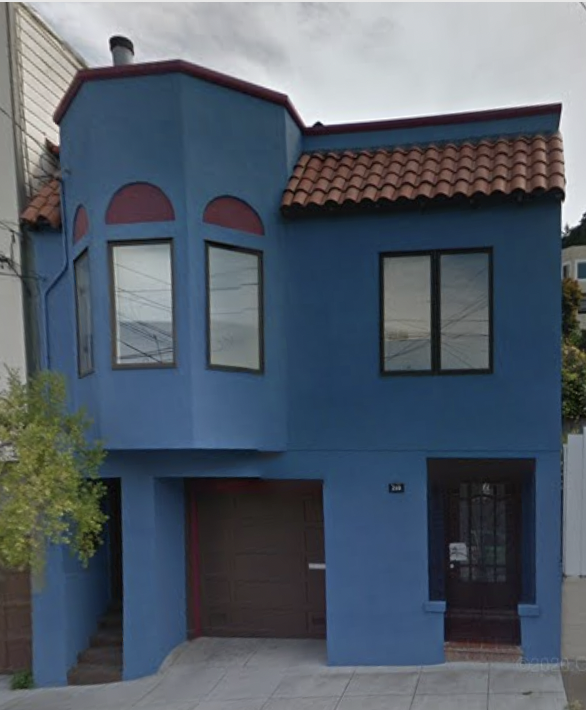
Michael and Ella must have left Oregon City soon after, for daughter Alice was born 20 Sept 1902 somewhere in California. Son Michael Tyrone was born 22 Dec 1906 in Portland, Oregon, so they obviously returned to Oregon for a while. However, they soon left for good. By 1910, the family was living at 8 Palmer Street, San Francisco, with Michael working as a carpet layer. A 1915 San Francisco city directory shows the family living at 289 Randall Street, and according to census records, Ella was still living there in 1930. What's more, I recently discovered that the house is still there! Next time we are in San Francisco, Mike and I plan to stop by.


Built in 1910, the house still stands at 289 Randall, now valued at $2.2 million,

according to Redfin.com (I'm not sure which is the most recent photo of the house)


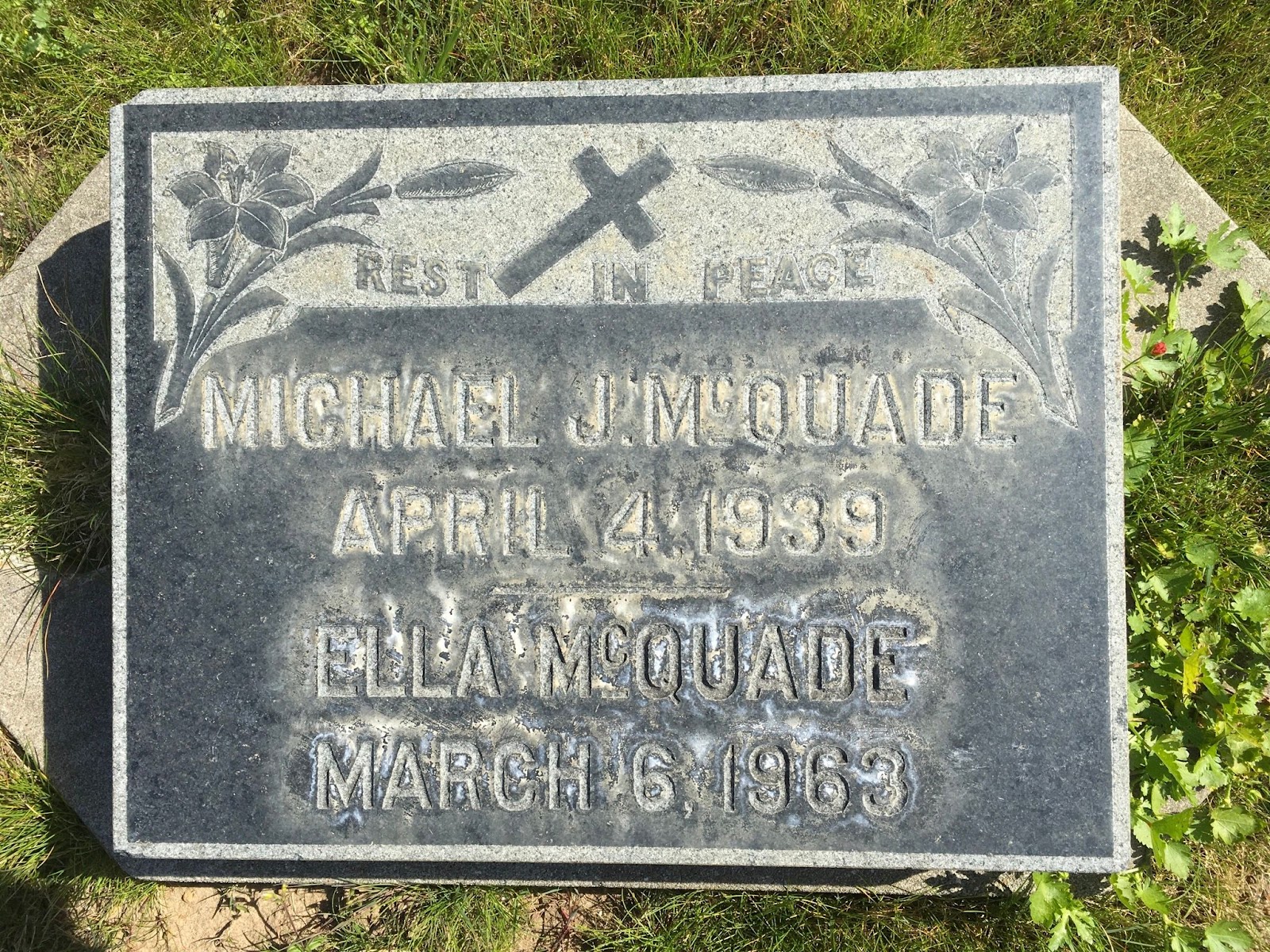
Michael died 4 Apr 1939 and is buried at Holy Cross Catholic Cemetery in Colma, San Mateo County, California. Ella died 6 Mar 1963. Her obituary lists her as “beloved wife of the late Michael J. McQuade.” It also describes her as “loving mother of Thomas V. McQuade, Mrs. Alice Lambert and the late Tyrone M. McQuade, survived by eight grandchildren; a native of Oregon.” She, too, is buried at Holy Cross Catholic Cemetery in Colma, where she and Michael share a headstone.


And wouldn't you know, even though that cemetery is only about 45 minutes away, Mike doesn't remember ever having visited it. I think perhaps all my family history research is sparking his curiosity a bit. The Colma cemetery is now on our list of future places to visit.


Following in My Great-Grandparents’ Footsteps: An Afternoon at Strawberry Hill in Golden Gate Park

Chasing History: Exploring My Ancestral Roots - Blog Post #59 By Tonya McQuade We enjoyed the views as we hiked to the top of Strawberry Hi...